How Whitefish earned the score
Population 7,751 residents (2020 census), in a town that hosts roughly a million visitors a year.
Situation Whitefish is a former Great Northern Railway division point that turned the mountain looming over town into one of the West’s most generous-feeling ski resorts, then leaned into its role as the closest real town to Glacier National Park.
Action The residents built their own ski mountain by hand, formed a community-owned company to run it, and kept the rail depot working so the town stayed a year-round destination rather than a one-season gateway.
Result Roughly a million visitors a year for a population under ten thousand, with tourism touching 43 percent of local jobs, a Visitor Impact Score of 96, and the Destination Leader band.
A Stump Town With a Million-Dollar View
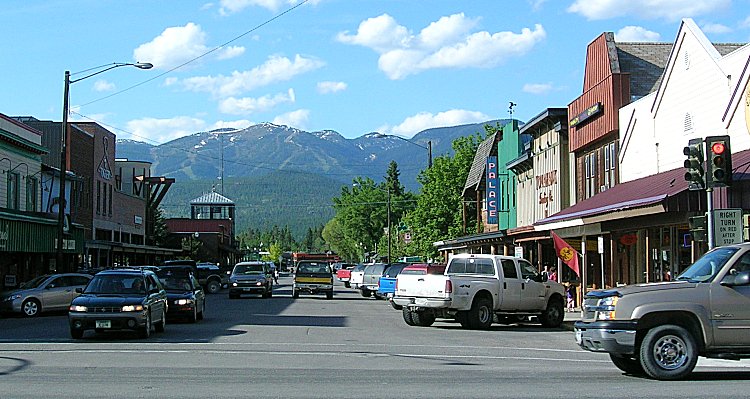
Drive into Whitefish today and the first thing you notice is how easy it is to like. A walkable Main Street of brick storefronts, a glacier-fed lake at the edge of town, and a ski mountain you can see from the bakery. None of that was inevitable. For most of a century, Whitefish was a working railroad town first and a resort second, and the order mattered.
The town owes its existence to a routing decision. When the Great Northern Railway rerouted its main line in 1904 to avoid the steep grade of Haskell Pass, it sparked the development of what became Whitefish, and by 1904 the town had taken over from Kalispell as the railroad’s division point, with hundreds of rail families moving up the line almost overnight (Wikipedia; BNSF). The place incorporated in 1905 and, by the rules of the day, automatically became a city once its population crossed 1,000 residents around 1910 (Wikipedia).
It earned a blunt nickname in the process. So much timber had to be cleared to lay the rails and raise the town that stumps were left standing right in the streets, and outsiders called it Stumptown, half teasing and half jealous of the boomtown going up in the woods (Whitefish Pilot). The name stuck so thoroughly that the local historical society still answers to it.
The asset hiding in plain sight
What Stumptown had, and did not yet use, was the mountain. Big Mountain rose just north of downtown, buried in some of the deepest snow in the Lower 48, an average of close to 300 inches a year (Whitefish Mountain Resort). It also had Whitefish Lake, a natural lake of about 5.2 square miles reaching 233 feet deep at the edge of town (Wikipedia). And it sat roughly 26 miles from the western edge of Glacier National Park, close enough to be the park’s most comfortable basecamp (Library of Congress caption). For decades, all three of those assets mostly watched the trains go by.
Turn Raw Geography Into a Reason to Stay
Plenty of Montana towns have mountains, lakes, and a national park within driving distance. Very few convert that scenery into a year-round visitor economy that locals can actually live on. That was the real task facing Whitefish across the twentieth century: take a town built around a rail yard and give visitors a reason to point the car at it, book a room, and come back.
The degree of difficulty is easy to underrate. Gateway towns can become parking lots, places people drive through on the way to somewhere more famous. Glacier National Park is the somewhere more famous. In 2024 it drew 3,208,755 visitors, whose spending in nearby communities reached $458 million and supported roughly 5,190 jobs and $656 million in total economic output across the gateway region (Flathead Beacon). The opportunity was enormous. So was the risk of being merely the off-ramp.
Whitefish’s answer was to build a destination of its own, one strong enough that the park became a bonus rather than the only draw. The town needed winter as much as summer, a downtown as much as a trailhead, and a personality that did not evaporate the moment Going-to-the-Sun Road closed for the season.
How a Town of a Few Thousand Built a Destination
The defining move in Whitefish’s tourism story is almost too on-the-nose. The town did not wait for a developer. It built the ski area itself.
The mountain the town built by hand
The dream started with a high-school teacher. Lloyd “Mully” Muldown arrived in 1928, and in the winter of 1933 he and a friend hiked up the forested slope above town and made the first recorded downhill descent, a peak he simply started calling “The Big Mountain” (Flathead Beacon). Muldown and a handful of other early skiers formed the Hell Roaring Ski Club, hiking up and skiing down a mountain with no lift, charging a dollar a night to defray the cost of the cabin (Flathead Beacon).
Muldown’s real genius was recruiting. He lured two outsiders, Ed Schenck and George Prentice, to come see what the mountain could be. In 1947 the pair sized up the site, put $20,000 of their own money into the venture, and helped form Winter Sports, Inc., a public company owned by community shareholders (Flathead Beacon; Wikipedia). Townspeople donated labor and free time to push through an all-weather mountain road, and on December 14, 1947, Big Mountain opened with a single T-bar, one main slope, and a lodge (Wikipedia). A town of a few thousand people had, quite literally, built itself a ski resort.
How a public company of neighbors built a ski mountain
Winter Sports, Inc. was not a private resort dropped onto the town. It was incorporated in 1947 as a public company of community shareholders, which is part of why locals felt ownership of the place from day one (Wikipedia). Ed Schenck went on to serve as general manager for more than 30 years and even enticed the world-famous ski instructor Toni Matt to open a ski school on the mountain, while George Prentice left in 1953 for better-paying work and returned in retirement to the slope he helped create (Flathead Beacon). The single 1947 T-bar was replaced by chairlifts in 1960 and 1968 as demand grew (Wikipedia).

Scaling the mountain without losing the town
The resort grew into a genuine destination without turning Whitefish into a theme park. After sixty years as Big Mountain, the resort was renamed Whitefish Mountain Resort in June 2007, when investor Bill Foley became the majority shareholder of Winter Sports, Inc. (Wikipedia). Today the mountain offers roughly 3,000 skiable acres, a 2,353-foot vertical drop from a 6,817-foot summit, and that near-300-inch annual snowfall, across about 110 named runs (Whitefish Mountain Resort). Crucially, the resort and the town are a quick drive apart, so the winter economy and the downtown reinforce each other instead of competing.
Keeping the front door open year-round
The second half of the action was refusing to be a one-season town. Whitefish kept its rail heritage working for it: the historic Great Northern depot still serves Amtrak’s Empire Builder, making it Amtrak’s busiest stop in Montana, with more than 68,000 passengers passing through as far back as 2006 (Wikipedia). That means a traveler can arrive in the middle of town by train, ski in winter, paddle Whitefish Lake in summer, and use the town as a Glacier basecamp in the shoulders. The Carol M. Highsmith Archive at the Library of Congress even documents the town’s small, specific charms, from the Buffalo Cafe to a hippie-styled Volkswagen camper at the edge of town, the kind of texture that turns a stopover into a stay (Library of Congress; Library of Congress).
Why arriving by train still matters here
Most ski towns require a car and a long mountain drive. Whitefish does not. The Empire Builder drops passengers at the restored 1920s-era depot a short walk from Central Avenue, and the station’s status as Amtrak’s busiest in Montana is a real, durable advantage for a town selling itself as low-friction (Wikipedia). It also ties the modern visitor economy directly back to the railroad that created the town in the first place, which is a tidy bit of brand continuity most resort towns would kill for.
A Million Visitors and a Main Street That Still Feels Like One
The results are easy to state and hard to overstate. Whitefish, a town of around 9,000 people, welcomes roughly a million visitors annually (Explore Whitefish). Tourism is not a side dish here; it is the main course. According to travel data analyzed for the local visitors bureau, 43 percent of all jobs in Whitefish are at least partially reliant on visitor spending, and visitor spending accounts for 58 percent of all spending at local businesses (Explore Whitefish).
That economy also funds the town. Whitefish collects a 3 percent resort tax on lodging, retail, bars, and restaurants, and in fiscal year 2025 those collections reached $6,978,640, up nearly 5 percent year over year (Whitefish Pilot). City estimates put the visitor contribution toward property-tax relief, infrastructure, housing, parks, and bike-and-pedestrian paths at just over $4 million (Whitefish Pilot). In plain terms, tourists help pay to keep the town livable for the people who live there.
And the bet on building its own destination paid off precisely because the park is so big. With Glacier drawing more than 3.2 million visitors and pumping $656 million into gateway economies in 2024, Whitefish gets to be both a destination and the smart basecamp, instead of just the off-ramp (Flathead Beacon). The population growth tells the same story from another angle: Whitefish grew 21.9 percent between the 2010 and 2020 censuses, adding 1,394 residents, as people decided the visit should be permanent (Whitefish Pilot).

What Other Towns Can Borrow From Whitefish
Whitefish is a clean case study in turning a single overlooked asset into a durable visitor economy. Three lessons travel well.
First, own your asset. The town did not wait for outside capital to build Big Mountain; residents formed a public company and donated labor to open it in 1947 (Wikipedia). Community ownership of the marquee attraction is rare, and it shows up decades later in how protective and proud the place feels.
Second, build a destination, not just a gateway. Being 26 miles from Glacier is a gift, but Whitefish refused to be only the door to someone else’s park. A self-made ski mountain, a swimmable lake, a train station downtown, and a genuine Main Street give travelers reasons to stay that have nothing to do with the park at all (Wikipedia).
Third, let visitors fund livability. A 3 percent resort tax channels millions back into property-tax relief, housing, and trails, which is how a tourism town keeps the goodwill of the people who actually live there (Whitefish Pilot).
The biggest opportunity from here is balance. When a town of nine thousand hosts a million visitors, the questions become seasonal and spatial: how to fill the shoulder weeks, how to move demand off the busiest summer days, and how to keep downtown thriving in the quieter blocks of the calendar. Whitefish has the rare luxury of optimizing a success rather than chasing one.