How Cooperstown earned the score
Population 1,794 village residents (2020 census), at the foot of Otsego Lake.
Situation A small, remote frontier village, already famous through James Fenimore Cooper’s novels, faced a quiet Depression era economy.
Action Backed by the Clark family fortune, the village built and endowed the National Baseball Hall of Fame and a cluster of serious museums and the Glimmerglass opera festival around it.
Result More than 17 million Hall of Fame visitors, roughly 260,000 a year, and $352 million in 2023 county visitor spending supporting about 2,878 jobs. Visitor Impact Score 96, band Destination Leader.
Situation: a small village with an outsized name
Drive into Cooperstown on a July afternoon and the math stops making sense. The village holds 1,794 residents as of the 2020 census, a single ribbon of Main Street, and a lake at its doorstep. Yet during the high season the daily turnstile count at one museum can rival the entire population of the town. This is a place built to a scale that its founders never imagined, and understanding how it got here means going back well before the first pitch.
The village was laid out in 1786 by the frontier developer William Cooper, who had purchased the land two years earlier and originally named the settlement Otsego, for the long glacial lake it sits at the foot of. The community was established enough by 1790 that Cooper moved his family up from Burlington, New Jersey, and the name eventually shifted to Cooperstown in his honor. [1]
That move brought a one year old boy who would make the surrounding hills famous on his own terms. James Fenimore Cooper grew up here and returned for the last fifteen years of his life, and in his Leatherstocking novels he gave Otsego Lake the nickname that still defines it: the Glimmerglass. [5] Long before anyone associated the village with bats and gloves, it was already a literary landscape, the setting that a generation of nineteenth century readers pictured when they imagined the American frontier.

Task: turn a legend into a place people travel to
By the 1930s, Cooperstown faced the same problem as a thousand other small American towns. The frontier story had aged, the lake was beautiful but quiet, and the Great Depression was draining what little tourism a remote village could attract. What Cooperstown had that almost nowhere else did was a story the entire country wanted to believe: that baseball, the national pastime, had been invented right here.
The seed was a 1907 finding by the Mills Commission, which declared that “the first scheme for playing baseball” had been devised by Abner Doubleday at Cooperstown in 1839. [6] Historians would later dismantle that claim almost entirely, but in the depths of the 1930s it handed Cooperstown a gift: a national origin myth with a specific street address. The task in front of the village and its leading family was to build something permanent on top of it, an institution worth crossing the country to see, in a place with no airport and no interstate.
This is the quiet genius of the Cooperstown model. The town did not wait for a highway or a corporate headquarters. It took a piece of cultural folklore, paired it with real philanthropic muscle, and decided to become the keeper of a national memory. That decision, more than the myth itself, is what built the modern village.
Action: the Hall, the lake, and a century of stagecraft
The Hall of Fame opens its doors
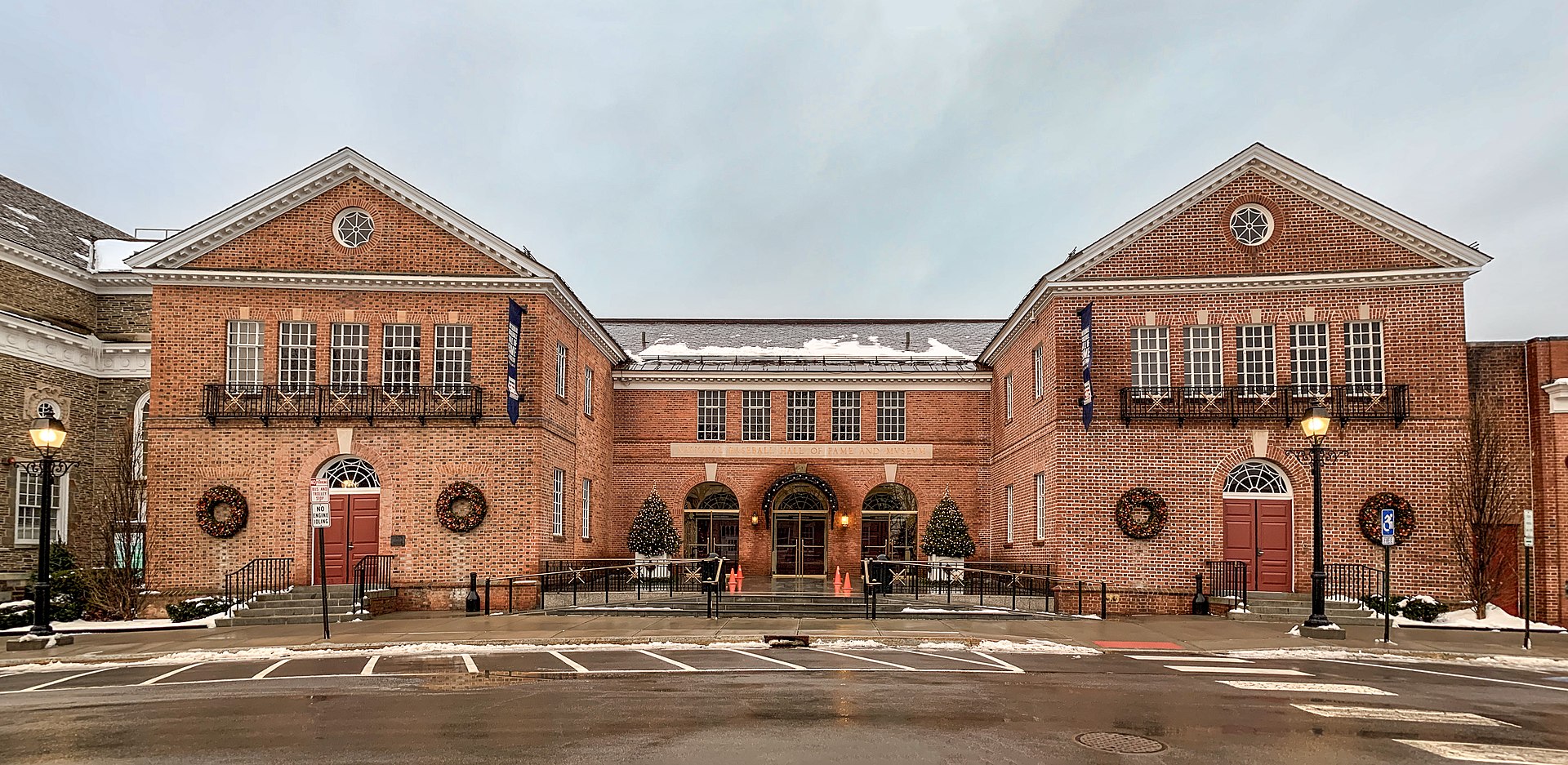
On June 12, 1939, the National Baseball Hall of Fame and Museum opened on Main Street, timed to what was then believed to be the sport’s centennial. [7] It was funded in large part by Stephen Carlton Clark, heir to the Singer sewing machine fortune, whose family had deep roots in the village. What opened as a modest shrine grew into a serious cultural institution. Today the museum holds roughly 40,000 three dimensional artifacts, more than 3 million library items, and some 250,000 photographs, with 354 inductees enshrined as of January 2026. [2]
A $20 million renovation rededicated in 2005 added 10,000 square feet of exhibit space and modernized the visitor experience without sacrificing the building’s reverent, almost church like feel. [7] Walk in on a busy weekend and the crowd is genuinely intergenerational: grandparents who remember the players on the plaques, parents, and kids clutching gloves they hope to one day get signed.
Induction Weekend: the village as a stage
Once a year, the late July induction ceremony transforms the village into the spiritual center of the sport. Crowds that routinely run into the tens of thousands descend on a town with a few thousand beds, and in 2007 the induction of Cal Ripken Jr. and Tony Gwynn drew an estimated 82,000 fans, the largest crowd the ceremony has ever seen. [7] For one weekend, a place with no traffic light to speak of operates at the scale of a small festival city, and every restaurant, inn, and sidewalk vendor for miles feels it.
The Glimmerglass Festival and a deeper bench
Cooperstown’s smartest long game has been refusing to be a one museum town. Eight miles up the lake, the Glimmerglass Festival stages grand opera and musical theater each summer in the lakeside Alice Busch Opera Theater. It welcomes roughly 30,000 to 35,000 patrons a year, swells its payroll from about 30 year round staff to 350 in summer, and ranks as the second largest summer opera festival in the United States. [4] Opera patrons behave differently from day trippers: many stay three or four nights to see a full slate of productions, which spreads their spending across the village’s inns and restaurants. [8]
Add the Fenimore Art Museum, rooted in the New York State Historical Association founded in 1899 and home to a celebrated collection of American folk and Native American art, and the neighboring Farmers’ Museum (now Fenimore Farm & Country Village), which opened in 1944 and preserves more than 23,000 artifacts across two dozen historic buildings, and the picture sharpens. [9] [10] Cooperstown is not a town with one attraction. It is a town with a cluster of serious institutions, almost all of them sustained by the same philanthropic family that built the Hall, arranged tightly enough to fill a multi day visit.
Why the Clark family matters more than the myth
Strip away the Doubleday legend and Cooperstown still has the institutions, because the real engine was never the story, it was sustained local philanthropy. The Clark family, enriched by the Singer sewing machine company, did not just fund the Hall of Fame in 1939. Their foundations have for generations underwritten the Fenimore Art Museum, the Farmers’ Museum, the Glimmerglass Festival’s home, and the Bassett medical complex that anchors year round employment. Most small tourist towns ride a single attraction and hope. Cooperstown was deliberately endowed, and that endowment is the difference between a roadside curiosity and a destination that has held its draw for the better part of a century.
Result: 17 million visitors and a quarter of a billion dollar economy
The cumulative numbers are staggering for a place this size. Since opening in 1939, the Hall of Fame’s running visitor total has surpassed 17 million, and in a typical year roughly 260,000 people walk through its doors. [2] That is a single museum drawing well over a hundred times the village’s population every year, in a town most travelers reach only by a deliberate detour off the interstate.
The ripple effects reach across the whole county. In 2023, visitors spent $352 million across Otsego County, supporting roughly 2,878 tourism related jobs, about 13 percent of all employment in the county. [3] The tax leverage is just as striking. According to a tourism impact report commissioned by I Love New York, without that visitor spending every local household would face an extra $1,835 in taxes a year to maintain the same level of public services. [3] In plain terms, the people who travel to Cooperstown are quietly subsidizing the people who live there.
The summer surge, by the numbers
Cooperstown’s visitation is famously seasonal, and that concentration is both its strength and its constraint. July and August carry the museum, the Glimmerglass season, and Induction Weekend all at once, while the shoulder and winter months run far quieter. A festival audience that lingers three to four nights, opera payrolls that quadruple for the summer, and an induction crowd that can top 80,000 in a single weekend show what the village is capable of when demand peaks. The strategic question is not whether Cooperstown can fill July. It is how much of the rest of the year it can learn to fill.
The opportunity: a destination leader with room to grow the calendar
Cooperstown earns its Visitor Impact Score of 96 and its Destination Leader band the honest way: a village of fewer than 1,800 people sustains a 17 million visitor institution, a top tier opera festival, two serious museums, and a quarter of a billion dollar county tourism economy. Few places its size anywhere in the country carry that kind of cultural and economic weight, and even fewer have done it for nearly a century.
The biggest opportunity, framed from public research, is seasonality. The village’s demand is heavily concentrated in summer, when the Hall, Glimmerglass, and Induction Weekend stack on top of one another. The same heritage assets that make July extraordinary, the lake, the literary history, the cluster of museums, the walkable Main Street, are largely dormant in the colder months. A village that has already proven it can turn a contested myth into a 17 million visitor pilgrimage has every ingredient to extend that pull into fall foliage, winter heritage programming, and spring shoulder travel. The story is written. The next chapter is about the calendar.
The Doubleday myth, told honestly
It is worth being straight about the legend at the center of all this. The claim that Abner Doubleday invented baseball in a Cooperstown pasture in 1839 came from the 1907 Mills Commission, which leaned heavily on a single elderly correspondent’s recollection. Modern historians consider the story essentially a myth: Doubleday was a West Point plebe in 1839 and left no known mention of baseball anywhere in his papers. [13]
And yet Doubleday Field, which opened on the supposed site in 1920, still hosts games, and the Hall of Fame is still here. [6] That is the real lesson of Cooperstown for any town chasing a visitor economy. A good story gets people in the door, but it is the institutions, the philanthropy, the curation, and the walkable sense of place that keep them coming back for eighty five years. Cooperstown built something true on top of something that probably was not, and the truth is what endured.
So who really invented baseball?
The honest answer is that nobody did, at least not in a single afternoon. Baseball evolved gradually from older bat and ball games like English rounders and town ball through the early nineteenth century, and the codified New York rules of the 1840s, associated with Alexander Cartwright and the Knickerbocker club, did far more to shape the modern game than any moment in a Cooperstown field. The village’s genius was never that the myth was accurate. It was that Cooperstown chose to become the place that honors the game, and then built the institutions to deserve it.
