How Traverse City earned the score
Population 15,678 in the city at the 2020 census, with about 153,448 across the four-county metro.
Situation A small harbor town on Grand Traverse Bay, handed a deep bay, a long growing season, and orchard soil, that spent 175 years learning to share it.
Action Stacked four overlapping draws on one identity: a century-old National Cherry Festival, 50-plus wineries across two AVAs, a walkable Front Street downtown, and a film festival.
Result Visitor spending across the greater region topped $1 billion in 2022, supporting nearly 9,000 jobs.
A town built on water and fruit
Drive north up the middle of Michigan’s Lower Peninsula and the land eventually runs out into a forked blue bay. That is Grand Traverse Bay, and the city wrapped around the bottom of its west arm is Traverse City, the largest city in Northern Michigan. The setting is the whole story here. The bay moderates the climate enough to grow fruit that has no business thriving this far north, the water draws boaters and swimmers all summer, and two long peninsulas split the bay into postcard views from almost every angle.
The town is younger than it looks. In 1847, Captain Horace Boardman of Naperville, Illinois bought the land at the mouth of the Boardman River and built a sawmill, and the settlement grew up around the lumber trade, according to the city’s recorded history. Four years later the Boardmans sold the mill to Hannah, Lay & Co, and one of its partners, Perry Hannah, became the figure now remembered as the Father of Traverse City. Over the next 35 years his company milled roughly a billion board feet of lumber and built much of the Front Street downtown that visitors still walk today. After the Great Chicago Fire, a good share of the wood that rebuilt the city came from these mills.
Today the city itself is small, with a population of 15,678 at the 2020 census, while the four-county metro area holds about 153,448 residents. That gap between a tiny year-round town and a region that hosts millions of visitors is exactly the tension a great hidden gem has to manage well, and Traverse City manages it about as well as anyone.

Turn a harvest into a destination
By the early twentieth century the orchards on the Old Mission and Leelanau peninsulas had made Northern Michigan the tart cherry capital of the country. The region still produces something close to 40 percent of the entire US tart cherry crop, which is why Traverse City answers to the nickname Cherry Capital of the World. But a great agricultural product does not automatically make a great visitor town. Plenty of farm regions feed the country without anyone planning a vacation around them.
The real task, repeated across generations, was conversion. How do you turn a harvest into an experience people travel for? How do you take a single landmark crop and build a calendar of reasons to come back, so the town is not living on one frantic week in July? And how do you do all of that without paving over the orchards, vineyards, and shoreline that make the place worth visiting in the first place? The answers Traverse City found, a festival, a wine country, a walkable waterfront, and a film scene, are what lifted it from a pretty farm town into a genuine destination.
The single ownable idea: cherries
Most towns struggle to name the one thing they own. Traverse City never had that problem. The cherry is its flag, its flavor, and its festival, and almost everything in the visitor economy hangs off that single, instantly understood idea. That clarity is rare and valuable. A visitor who has never been here already knows what the town is about before they arrive.
Festivals, wine trails, and a walkable bay
The flagship move was the festival. What is now the National Cherry Festival began modestly in 1925 as the Blessing of the Blossoms, a springtime celebration of the orchards, and the Michigan Legislature renamed it the National Cherry Festival in 1931. It has run nearly every year since and turned 100 years old in 2025. The eight-day event now draws crowds in the hundreds of thousands; a Grand Valley State University assessment of the 2022 festival counted roughly 323,500 visits, nearly 75 percent from outside the county, spending about $22 million in a single week. That is a remarkable return for one idea, executed consistently for a century.
A wine country grew up alongside the orchards
The same microclimate that ripens cherries also ripens grapes. The land around the city now holds over 50 wineries across two federally recognized American Viticultural Areas, the Old Mission Peninsula and the Leelanau Peninsula. This matters because wine tourism runs on a different clock than the cherry harvest. Tasting rooms pull visitors through the shoulder seasons of spring and fall, smoothing out the brutal seasonality that hollows out so many summer towns. A couple can build an entire weekend around peninsula drives, tasting flights, and bay views without the cherries being in season at all.
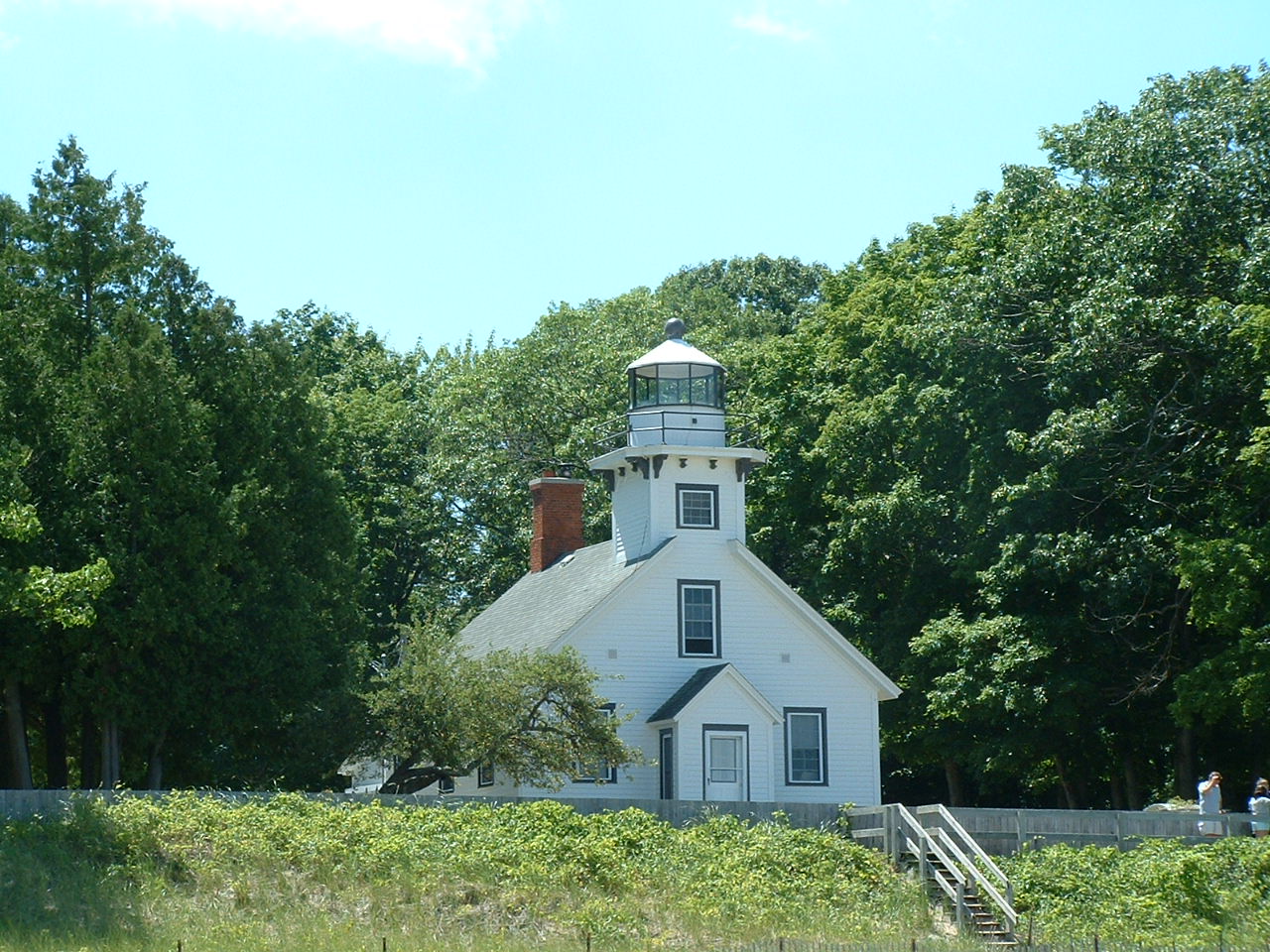
That lighthouse is its own quiet draw. Mission Point Light was built in 1870 at the end of the Old Mission Peninsula, a few hundred yards south of the 45th parallel, the exact midpoint between the Equator and the North Pole. The park around it welcomes roughly 100,000 visitors a year. It is the kind of free, photogenic, geographically meaningful landmark that gives a region a postcard and a reason to drive twenty minutes past the orchards to the water’s edge.
A walkable downtown and a film festival
The fourth move was making the town itself worth lingering in. The historic Front Street commercial district, much of it built by Hannah’s lumber money, gives the city a dense, walkable core of restaurants, shops, and theaters right where the river meets the bay. In 2005 the filmmaker Michael Moore, author Doug Stanton, and photographer John Robert Williams co-founded the Traverse City Film Festival, screening independent films in restored downtown venues like the State Theatre and the City Opera House. For two decades it added a mid-week, late-summer draw that local businesses credited as a real economic boost between weekend crowds, before it wound down after the 2023 season.

Why the cherry held when the lumber ran out
Lumber towns across the Great Lakes boomed and then collapsed when the old-growth forests were cut over. Traverse City could easily have followed that arc into decline. What saved it was a second act already growing in the cutover land: orchards. Farmers discovered that the same bay-moderated climate that the loggers had never cared about was nearly perfect for fruit. The town pivoted from extracting a resource that ran out to cultivating one that comes back every single year, and then learned to sell the experience of it. That pivot, from a finite harvest to a renewable one, is the quiet reason the town survived its founding industry.
The 45th parallel, and why that matters here
Traverse City sits almost exactly halfway between the Equator and the North Pole. That latitude is not just trivia on a roadside sign at Mission Point. It is the same band of the globe that produces celebrated cherries and cool-climate wines elsewhere in the world, and it gives the region long summer days, crisp falls, and a growing season tuned for the exact fruit the town is famous for. Geography, in other words, is not a backdrop in Traverse City. It is the product.
A billion-dollar visitor economy
The numbers are the proof. A study prepared for Traverse City Tourism by Tourism Economics, part of Oxford Economics, found that visitors to the greater Grand Traverse region spent $1 billion in 2022, about 23 percent above pre-pandemic levels. That spending produced a $1.4 billion local economic impact, supported 8,954 local jobs, yielded $349 million in labor income, and generated $134 million in state and local taxes. For a year-round city of fewer than 16,000 people, that is an extraordinary multiplier.
Zoom in on Grand Traverse County alone and the trend keeps climbing. Visitors spent about $630.8 million in the county in 2023, up from $583.8 million in 2022 and $493.2 million in 2021, according to the Pure Michigan Tourism Economic Impact Report. The wider Northwest Michigan region drew an estimated 14.2 million visitors in 2023. This is not a town getting by on a single festival weekend. It is a regional economy that has learned to convert scenery and agriculture into sustained, growing demand.
Just as telling is the institutional maturity behind the numbers. The region’s destination marketing organization was founded in 1981 as the Traverse City Area Convention and Visitors Bureau and rebranded as Traverse City Tourism in 2013. A town with a 40-year-old professional tourism body, a century-old festival, and a named wine region is not improvising. It is running a destination on purpose.
The score and the opportunity
On the Visitor Impact Score, Traverse City earns a 100 and lands squarely in the Destination Leader band, at Tier 1, provisional. That reflects a town with a crystal-clear identity, a diversified set of attractions, a measurable and growing economic impact, and the institutions to sustain it. Very few small towns in America convert their geography into visitor value this completely.
The biggest opportunity, framed from the public record rather than any internal metric, is seasonality and dispersion. The festival, the beaches, and the bay concentrate enormous demand into a short summer window, which strains a small year-round community and leaves shoulder seasons comparatively quiet. The wine trails and the indoor downtown already point the way toward spreading that demand across spring, fall, and winter. The town that figures out how to make November feel as essential as July will protect both its residents’ quality of life and its own long-term growth. For a place that already does almost everything right, that is a genuinely good problem to have.