
What Stettler is known for
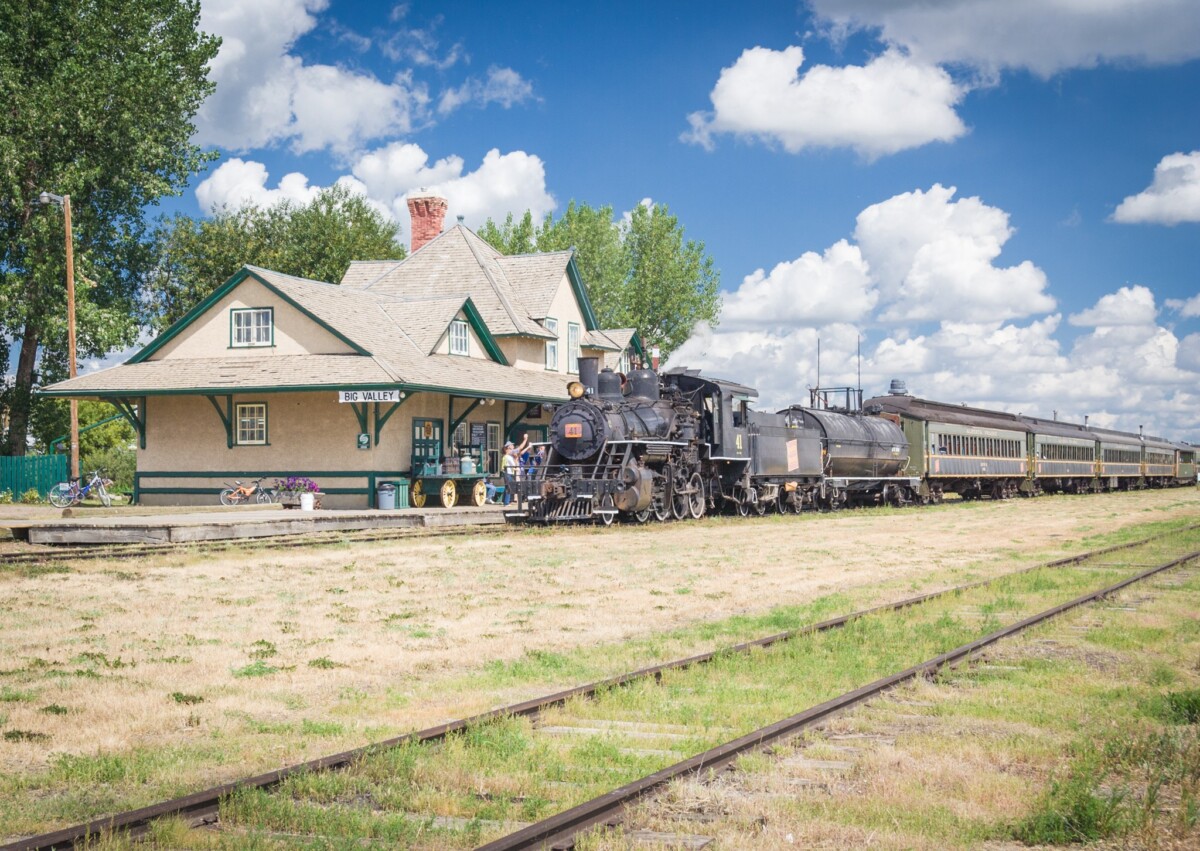
Stettler is an Alberta town of 5,695 people at the 2021 census, named for Swiss immigrant Carl Stettler, and it is known for Alberta Prairie Railway Excursions. The company, in operation since 1990, runs trips on the 34.1 km line between Stettler and Big Valley. Trains stop at Big Valley, with its restored 1912 railway station, or at the company’s Country Hideaway at Warden Junction.
Two accounts of the land
The town’s own land acknowledgement places Stettler on Treaty 7 territory and names Métis Nation Region 3. Treaty 7 was signed on September 22, 1877, at Blackfoot Crossing on the Bow River, by the Siksika, Piikani and Kainai of the Blackfoot Confederacy, the Tsuut’ina Nation, and the Bearspaw, Chiniki and Wesley bands of the Stoney Nakoda. A popular local history instead says the Blackfoot and the Cree occupied the area for centuries, and names no treaty. The Cree are not among Treaty 7’s signatories, so the two accounts differ.
From Blumenau to Stettler
Carl Stettler, born in Switzerland in 1861, came to Alberta in 1903 and in 1905 founded a small Swiss colony called Blumenau, which grew to include a lumberyard, two general stores, a tavern and a bakery. When the Canadian Pacific Railway reached the area that fall, the Blumenau settlers moved their businesses to the new rail-line townsite, and as postmaster he gave it his name. The Canadian Northern Railway reached Stettler in 1911, and it built the branch line the excursion trains now use.
Trains due to go back to Alabama
Don Gillespie and Jean MacDonald of MacDonald’s Resort in Buffalo Lake organized a group to buy the trains and station, and the rescued equipment had been due to be sent back to Alabama before the group stepped in. Gillespie put up the money, then sold shares to other investors while keeping majority control. A 2018 Ponoka News article puts the purchase 29 years earlier, in 1989, and Wikipedia says operations began in 1990. For a time, until the end of the 1999 season, the company also ran a 97 km route to Coronation, since abandoned.
The line today
The company reported more than 28,234 guests from more than 31 countries in 2023, and general manager Bob Willis said a single busy weekend can bring about 1,600 visitors into Stettler. A staged train robbery on board raises money for children’s charities. When COVID-19 halted passenger excursions in 2020, the company nearly doubled its freight tank-car storage capacity, from about 400 to 800 cars. The track now belongs to the East Central Alberta Heritage Society, which leases it to the company. The rail bed crosses what the town calls Treaty 7 territory, and the railway’s own materials do not say so.
Questions people ask about Stettler
What is Alberta Prairie Railway Excursions?
An excursion railway that runs trips on the 34.1 km line between Stettler and Big Valley, Alberta, originally built by the Canadian Northern Railway. It began operations in 1990, and its trains stop at Big Valley's restored 1912 station or at the company's Country Hideaway at Warden Junction.
Does the Alberta Prairie Railway run steam trains?
It runs both steam and diesel locomotives. They include a 1920 2-8-0 steam locomotive, which Wikipedia's article on the railway credits to Baldwin in its text and to Montreal Locomotive Works in its infobox, and diesels including a 1957 SW-1200, a 1958 GMD1 and a 1957 EMD GP9.
How many people ride the Alberta Prairie Railway?
The company reported more than 28,234 guests from more than 31 countries in 2023. Its general manager, Bob Willis, said a single busy weekend can bring about 1,600 visitors into Stettler, a town of 5,695 people at the 2021 census.
Whose land is Stettler on?
The town's own land acknowledgement places Stettler on Treaty 7 territory, signed in 1877 by the Siksika, Piikani and Kainai, the Tsuut'ina Nation and the Bearspaw, Chiniki and Wesley bands of the Stoney Nakoda, and names Métis Nation Region 3. A popular local history instead says the Blackfoot and the Cree occupied the area for centuries.
Who was Carl Stettler?
A Swiss immigrant, born in 1861, who came to Alberta in 1903 and founded the Swiss colony of Blumenau in 1905. When the Canadian Pacific Railway arrived that fall, the colony's businesses moved to the rail-line townsite, and as postmaster he gave it his name. He died in Memphis, Tennessee, in 1920 and is buried in Stettler.