
What Vegreville is known for
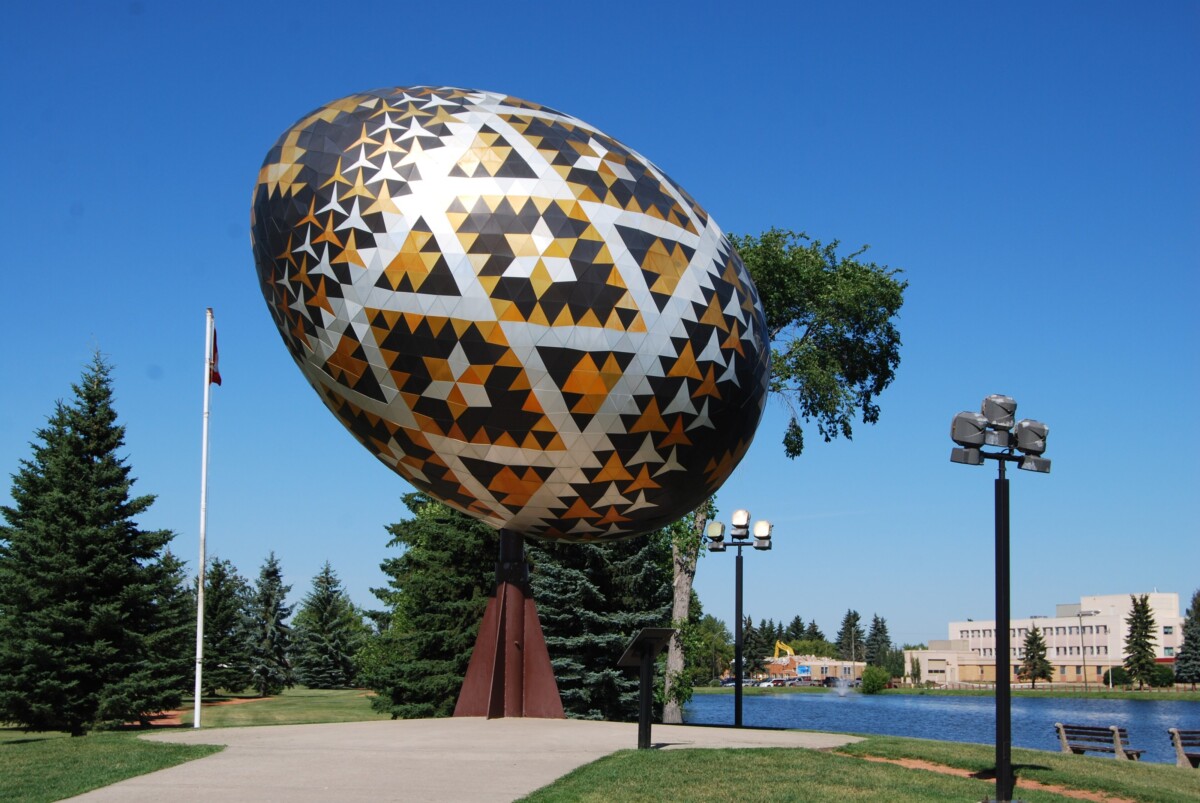
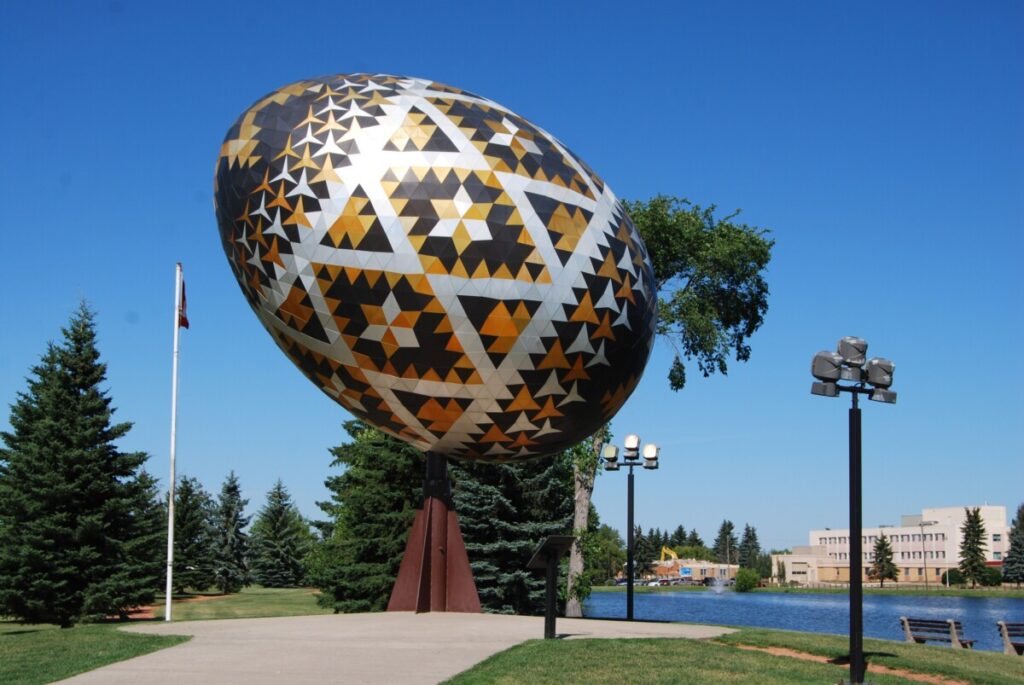
Vegreville is an Alberta town of 5,689 people at the 2021 census, about 103 km east of Edmonton, and it is known for a giant pysanka. By the town’s own figures it stands 31 feet high, 25.7 feet long and 18 feet wide, and sources agree it has 3,512 visible facets, 6,978 nuts and bolts and 177 internal struts. It was conceived to mark the RCMP’s centennial and to represent Vegreville’s Ukrainian heritage.
A rest stop by a lake, then settlers
Oral histories say Indigenous bands used a hill and lake east of the future townsite as a rest stop. The area is said to have been called Beaver Hills Lake, and local farmers later found petrified pemmican and arrowheads. The sources for this story do not name the nation. The first non-Indigenous settlers, Dick Steele and Billy Inglis, arrived in 1881 to farm the east shore of the lake. French-Canadian families from Kansas followed in 1894, then English settlers, then a larger wave from central and eastern Europe and the British Isles, Ukrainians among them. By the 1950s more than 30 ethnic groups lived in the area.
A town that moved to the railway
The town is named for Father Valentin Vegreville, a Roman Catholic Oblate missionary. The railway reached a new site in October 1905, about 4.5 miles northeast of the original hamlet, and by the end of that winter Old Vegreville was an empty site. Vegreville was incorporated as a village and then as a town in 1906.
Why a pysanka
The town’s own site says the Chamber of Commerce gave two reasons for the design: the peace and security the RCMP was said to have brought to the area, and Ukrainian heritage. Paul Maxym Sembaliuk, a Canadian artist of Ukrainian descent, designed its colours and pattern, and Ronald Resch, a computer scientist at the University of Utah, worked out the geometry that turned the flat pattern into a three-dimensional structure; Wikipedia also credits Robert McDermott with algorithm development. The Royal Canadian Mint says the sculpture took more than 12,000 hours to design, manufacture and assemble.
Finished in 1974 or 1975
Sources disagree on when it was finished: Wikipedia’s Vegreville article and pysanky.info give 1974, while the Royal Canadian Mint says it was constructed in 1975. Queen Elizabeth II and Prince Philip visited Vegreville in 1978 to see it, and in 2009 it was one of four attractions on the first set of stamps in Canada Post’s Canadian Roadside Attractions series. The pysanka gives Vegreville’s many histories one image, and the image simplifies: the first non-Indigenous settlers were English-named, French-Canadian families came next and Ukrainians in a later wave, and the bands who rested by the lake before any of them go unnamed in the sources.
Questions people ask about Vegreville
How big is the Vegreville pysanka?
The town's own site gives it as 31 feet high, 25.7 feet long and 18 feet wide, and Wikipedia gives its weight as about 2.5 tonnes. Sources agree it has 3,512 visible facets, 6,978 nuts and bolts and 177 internal struts, but they split on its triangles: Vegreville's own site counts 2,208, and Wikipedia's article on the sculpture counts 1,108.
Why was the Vegreville pysanka built?
It was conceived to mark the RCMP's centennial. The town's own site says the Chamber of Commerce gave two reasons for the design: the peace and security the RCMP was said to have brought to the area, and Vegreville's Ukrainian heritage. Sources disagree on who commissioned and paid for it.
When was the Vegreville pysanka built?
Sources disagree. Wikipedia's Vegreville article and pysanky.info give 1974. Wikipedia's article on the sculpture ties its dedication to the RCMP's 1975 centennial, and the Royal Canadian Mint says it was constructed in 1975.
Who designed the Vegreville pysanka?
Paul Maxym Sembaliuk, a Canadian artist of Ukrainian descent, designed its colours and decorative pattern. Ronald Resch, a computer scientist at the University of Utah, worked out the geometry that turned the flat pattern into a three-dimensional structure, and Wikipedia also credits Robert McDermott with algorithm development.
Who were the first settlers at Vegreville?
Oral histories say Indigenous bands used a hill and lake east of the future townsite as a rest stop, though the sources do not name the nation. The first non-Indigenous settlers, Dick Steele and Billy Inglis, arrived in 1881, and French-Canadian families from Kansas followed in 1894.