How Ashland earned the score
Population 21,360 (US Census 2020)
Situation The Southern Pacific railroad bypassed Ashland in 1927 and the Great Depression finished the job, leaving a small southern Oregon town without its economic anchor.
Action Angus Bowmer built a Shakespeare festival, staged in 1935 in a roofless Chautauqua building, into the year-round economic anchor of the town.
Result The Oregon Shakespeare Festival now draws about 400,000 visitors a year and roughly 32 million dollars in tourism revenue.
Let’s Meet Ashland, Oregon
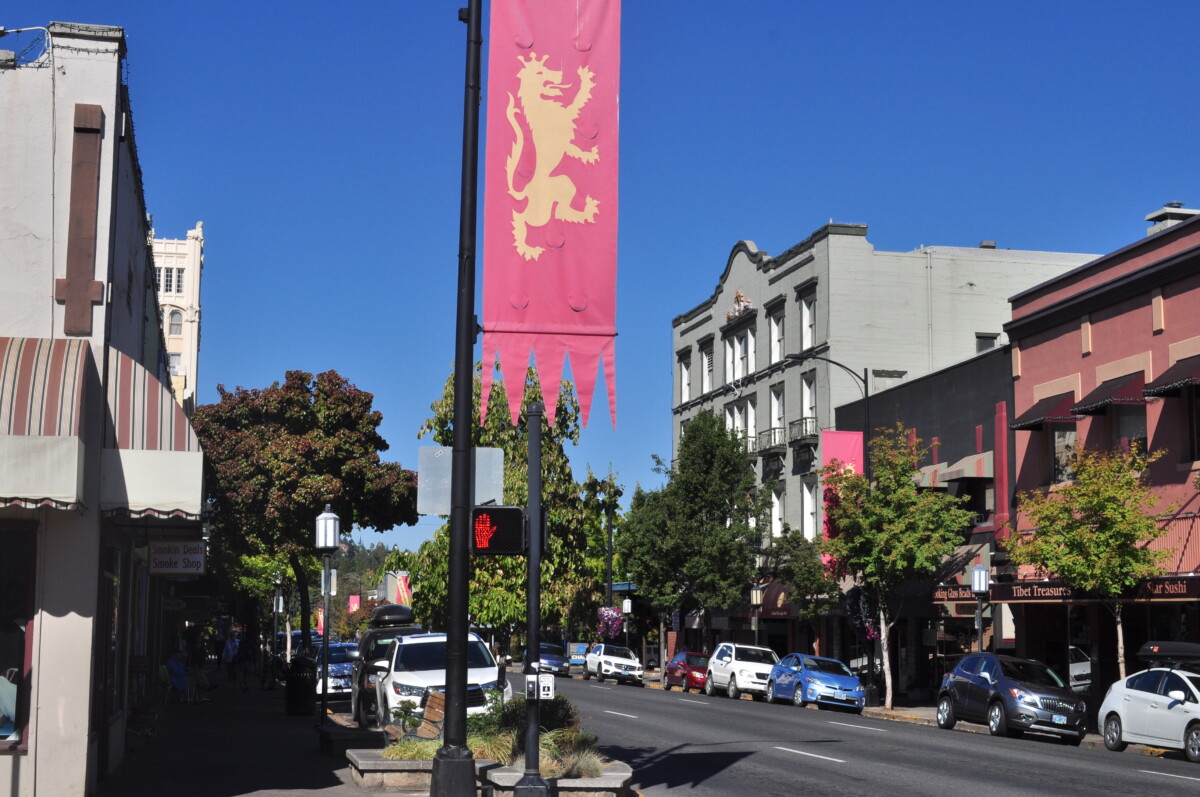
Ashland sits at the south end of the Rogue Valley, five miles from the California line, and on paper it has no business being the cultural capital of southern Oregon. The town is roughly twenty-one thousand people stitched into a narrow valley between the Siskiyou and Cascade ranges, two hundred and twenty-nine miles from Portland and well off the I-5 main vein for anyone heading from San Francisco to Seattle. Its anchor industry vanished in 1927. Its second economic backstop, the Chautauqua circuit, walked out of town not long after. And then in the middle of the Great Depression a stage actor with a roofless building decided he was going to do Shakespeare here. My Roger-Brooks sense is tingling all over this one.
The result, ninety years later, is the Oregon Shakespeare Festival, the largest nonprofit repertory theater company in the United States, and one of the cleanest examples in this field study of a single creative city development carrying a town for a full generation and beyond. Around 400,000 visitors a year now buy tickets, eat dinner, fill hotel rooms, and walk through Lithia Park, all because of a 1935 Fourth of July experiment in a building that had lost its roof.
History
The valley around Ashland Creek was Shasta country before any of this. Hudson’s Bay Company hunters and trappers cut through on the Siskiyou Trail in the 1820s, and the Donation Land Claim Act pulled American settlers into the Rogue Valley in the early 1850s. The clashes that followed, later named the Rogue River Wars, ran through 1856. The town the settlers built came up fast: in 1851 gold turned up at Rich Gulch on a tributary of Jackson Creek, sixteen miles north at what is now Jacksonville. In January 1852 a small group including Robert Hargadine, Abel Helman, Sylvester Pease, and Eber Emery filed the first donation land claims around Ashland Creek. Helman and Emery built a sawmill on what they called Mill Creek; in 1854 they put up the Ashland Flouring Mills with M. B. Morris. The community settled on the name Ashland Mills after Helman’s home town of Ashland, Kentucky, and a post office opened under that name in 1855. The Post Office dropped the “Mills” in 1871, and Ashland Woolen Mills became the town’s main employer, weaving local wool into clothing and blankets through the 1860s and 1870s.
Reverend J. H. Skidmore opened Ashland Academy in 1872, which evolved over the next half century into Southern Oregon University, chartered as a state institution in 1926. The school is in the case-study story because it had a Speech and Drama Department by 1932, three years before the festival started, and one of its young actor-tutors was a man named Angus Bowmer.
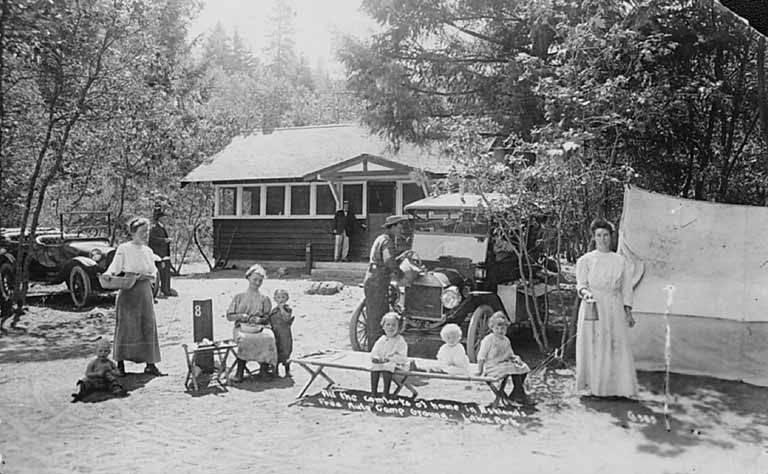
The boom phase came from the Southern Pacific Railroad. In 1887 the rail line from Portland down through the Rogue Valley connected to the line up from San Francisco at Ashland, and the town was suddenly the junction where the Siskiyou grade started. Pears, peaches, and apples from the Rogue Valley moved out on Southern Pacific cars; the Enders Building in town housed, from 1910 to 1928, what was reportedly the largest mercantile establishment between Sacramento and Portland. In 1908 the Women’s Civic Improvement Club petitioned for a community park along Ashland Creek. The town engaged John McLaren, the landscape architect of Golden Gate Park in San Francisco, to design what became Lithia Park, named for the local lithia springs that voters had once approved bonds to pipe in. The mineral spa plans collapsed in 1916, but the park survived and is still one of the two anchors of downtown Ashland.
In 1927 the railroad pulled the rug. Southern Pacific completed the Cascade Line east through Klamath Falls, which bypassed the steep Siskiyou grade and bypassed Ashland with it. The trains stopped, the freight stopped, and two years later the Great Depression took out whatever was left. By the early 1930s Ashland looked like the kind of town that quietly drops off the map.
Ashland’s Creative City Development
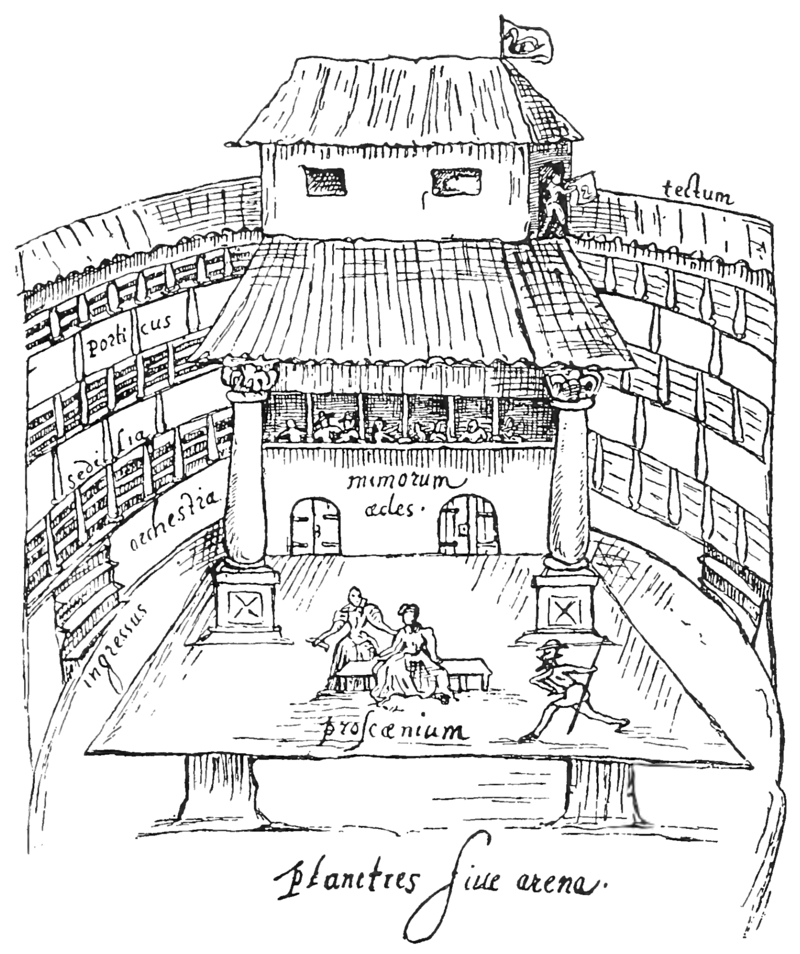
Angus Bowmer’s first season ran on a Fourth of July weekend in 1935. He had a roofless building left over from Chautauqua days and a deal with the city council: he could use it for plays if he also staged boxing matches to draw a crowd. The boxing lost money. The plays did not. Bowmer’s choice of Shakespeare for a logging-and-mining town in southern Oregon was not obvious in 1935, and it never quite stopped being surprising, which is part of why it worked. The thing audiences kept saying about that first season was that the productions felt close, which his University of Washington mentor Ben Iden Payne had drilled into him as a principle: an audience should be intimately near the performance, not separated from it by a proscenium and a hundred feet of orchestra pit.
The Oregon Shakespeare Festival
The festival grew slowly through the late 1930s, paused from 1941 to 1946 while Bowmer served in the military, and then re-launched in 1947. In 1951 a run of abbreviated radio adaptations went out to a hundred American radio stations; by 1954 the broadcasts had moved to Armed Forces Radio and Radio Free Europe. A LIFE magazine spread brought the crowds in. By the 1960s Ashland was hosting visitors from outside the Rogue Valley specifically to see the plays, which is the moment a town stops being a town with a theater and becomes a destination with a theater inside it.
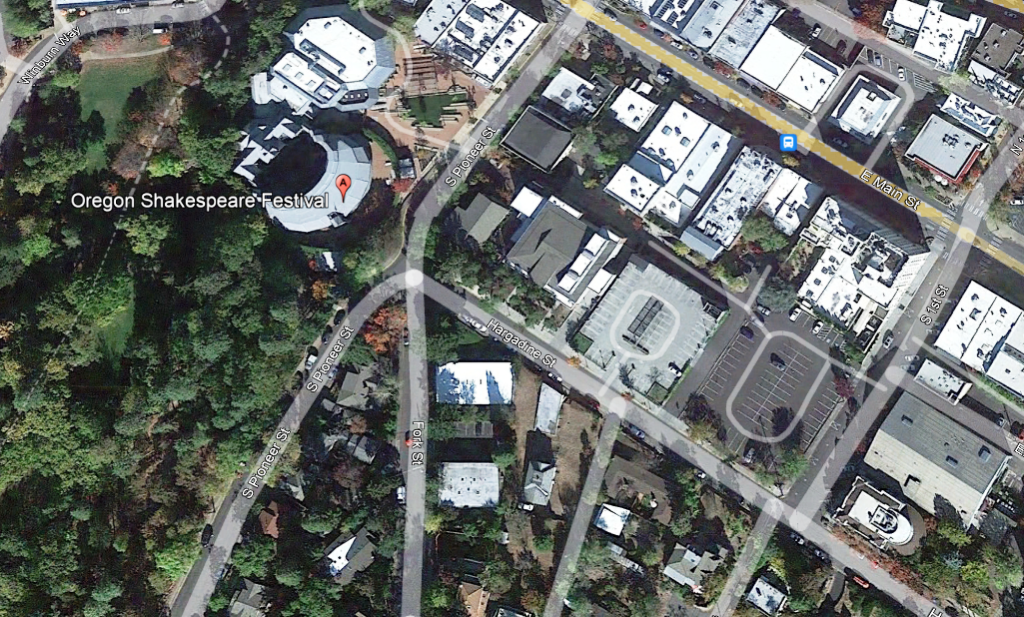
The campus today occupies four acres on the south edge of downtown. Three theaters surround a central courtyard: the outdoor Allen Elizabethan Theatre, an Elizabethan-style replica of the original 1935 stage; the Angus Bowmer Theatre, the indoor mainstage; and the Thomas Theatre, a more flexible black-box space. The season runs roughly March through October with nine to ten plays in rotating repertory. Per the festival’s published data, the campus draws about 400,000 visits a year and pumps approximately 32 million dollars into the Ashland economy. The case-study figure is conservative; the festival is the largest nonprofit repertory theater in the United States and the only professional multi-play Shakespeare repertory in the western US.
Lithia Park and the cultural stack
The Oregon Shakespeare Festival is the anchor, but it is not the only thing in town. Lithia Park, the John McLaren design from 1908, runs ninety-three acres up Ashland Creek out of the downtown plaza, and the festival campus opens directly onto it. The combined effect is that someone visiting Ashland for a play also walks under old-growth trees, past the lithia fountain, and through a downtown that did not lose its 1880s and 1890s housing stock during the lean years. The city has 59 individually listed structures and four full historic districts on the National Register: Downtown, Siskiyou-Hargadine, Railroad, and Skidmore Academy. The roster includes the Enders Building, the Orlando Coolidge House from 1875, the John McCall House from 1883, and the Nils Ahlstrom House from 1888. Southern Oregon University on the north edge of downtown adds a sizable student population, performing arts programming, and a feeder pipeline of regional theater talent.
Economic Impact
The headline numbers come from the festival itself and from the CCD case study record: roughly 400,000 visitors per year and about 32 million dollars in direct tourism spending. TripAdvisor reviews across the major attractions and lodging properties cluster around 4.5 to 4.8 stars, including the OSF productions, Lithia Park, the Ashland Springs Hotel, and the downtown restaurants. travelashland.com lists eight lodging categories, from hostels through retreats and country lodges, which is unusual depth for a town of this size. The Ashland Springs Hotel, built in 1925 as the Lithia Springs Hotel, anchors the downtown segment; the Columbia Hotel (in the Enders Building) and Ashland Hills Hotel and Suites round out the four-star tier.
How the categories scored
The uniqueness multiplier reflects the genuinely one-of-a-kind character of the festival within a 100-mile radius. The category leader was Stay at 96.3 and the category laggard was Return at 84.6; both are still tier-A. The Downtown and Curb-appeal categories are pending an in-person audit and are not yet scored.
Community Benefits
The off-season programming is what separates Ashland from the towns that have one festival and nine quiet months. The OSF season runs March through October. The Festival of Light runs from the day after Thanksgiving through mid-January and is in its 33rd year as of 2025. Independence Day has been on the town calendar for over a century and is one of the heavier weekends of the summer. The Oregon Chocolate Festival anchors February, the Halloween parade fills the last weekend of October, and the spring shoulder benefits from Oregon Wine Month programming. Ashland also stacks an active food and wine culture on top of all of this, including farm tours and the culinary economy that grew up to feed festival audiences. Locally, that calendar means residents are not staring at empty storefronts in January, which is the failure mode for towns that try to do a single summer festival and call it a strategy.
Why Other Towns Should Follow Ashland’s Lead
Ashland ran the same play any town can run, but it ran it for ninety years, which is the part most towns get wrong. There are three things to take from this. First, the anchor was not a building, a brand, or a marketing campaign; the anchor was an institution, the Oregon Shakespeare Festival, that compounded year over year because the town kept investing in it. Second, the town protected the off-season. Festival of Light, Halloween, Chocolate Festival, Independence Day: the calendar never goes dark for more than a few weeks. Third, the town kept the physical fabric. The 59 listed historic structures, the John McLaren park, the 1925 Ashland Springs Hotel, the 1880s downtown grid; none of it was demolished and rebuilt in 1965 or 1985 when that was what most American towns were doing. A festival that delivers 400,000 visitors a year still needs the town around it to look like somewhere worth coming to. Ashland’s most underrated decision was the long string of small decisions to keep the old buildings standing.