How Clarksdale earned the score
Population 14,903 (US Census 2020), a number that has been falling for decades.
Situation A small Delta cotton town, once the Golden Buckle on the Cotton Belt, that lost more than a third of the economy that built it and now carries one of the highest poverty rates in Mississippi.
Action Leaned all the way into the one thing no other place on earth can claim: the blues was born here, and it is still played here in living juke joints, a museum, and a festival that fills the streets.
Result The Juke Joint Festival draws more than 7,500 visitors from all fifty states and dozens of countries each April, hotel rooms book up to two years ahead, and a downtown most people had written off is filling back in one storefront at a time.

Let’s meet Clarksdale, MS
Stand at the corner of Highways 61 and 49 in Clarksdale and there is not much to see. A tangle of wires, a gas station, and a tall pole holding three blue guitars against the Delta sky. It is one of the most visited empty intersections in America. This is the Crossroads, the spot a 1999 Mississippi state resolution named as the place where, in the story every blues fan knows by heart, a young Robert Johnson met the devil at midnight and traded his soul for the ability to play. The legend is almost certainly not literally true. Johnson himself was not even from Clarksdale. And yet people come from Tokyo and Oslo and Sao Paulo to stand here and take a photograph, because the story is true in the way that matters: something happened in this flat, hot, poor stretch of cotton country that changed the sound of the entire modern world.
Clarksdale sits in Coahoma County, about seventy five miles south of Memphis on the old Blues Highway. The 2020 census counted 14,903 people, and that number has been falling for decades. John Clark founded the town in 1848 on a timber business, and it incorporated in 1882 as cotton and the railroad turned it into one of the richest agricultural towns in the South, the self styled Golden Buckle on the Cotton Belt. The wealth ran on the backs of Black sharecroppers, and it was in their fields and churches and Saturday night gatherings that the Delta blues took shape. When the machines came and the cotton economy collapsed, the money left with it. What stayed was the music, and the memory of who made it.
The roll call of names tied to this one small town is almost hard to believe. Muddy Waters, the man who electrified the blues and lit the fuse on rock and roll, grew up a sharecropper on the Stovall Plantation just outside town, where the Library of Congress first recorded him in 1941. Ike Turner was born in Clarksdale, and his band cut Rocket 88 in 1951, a record many historians call the first rock and roll song. John Lee Hooker came from just up the road. Son House played these juke joints. Sam Cooke was born here. Bessie Smith died at the old G. T. Thomas hospital on the edge of downtown, a building that is now the Riverside Hotel where blues travelers still sleep. The disc jockey Early Wright broadcast the blues over WROX from 1945 to 1998, one of the first Black radio voices in the state. Even the playwright Tennessee Williams spent much of his boyhood in the Clarksdale rectory where his grandfather preached.
To understand why the world cares, you have to follow the music out the door. In the 1940s and 1950s, thousands of Black Delta families boarded the Illinois Central at the Clarksdale depot and rode Highway 61 north to Chicago and Detroit, part of the Great Migration. Muddy Waters was one of them. He left Stovall in 1943, plugged his guitar into an amplifier in a loud Chicago bar, and turned a rural acoustic music into something that could cut through a crowd. That electrified Chicago blues became the direct ancestor of rock and roll; the young Rolling Stones took their name from a Muddy Waters song. So the intersection tourists photograph is not just a local curiosity. It is the headwaters of a river that runs through the Beatles, Led Zeppelin, and nearly everything that followed. The other road at the Crossroads, Highway 49, ran to Parchman Farm, the state penitentiary whose work songs seeded the music from the other direction.
How Clarksdale found its thing
For most of the twentieth century Clarksdale did not think of the blues as an asset. It was just the sound of the place, and much of white Clarksdale barely noticed it while much of the money that the music generated flowed to Chicago and beyond with the musicians who left. The turn began quietly in 1979, when Sid Graves, the director of the Carnegie Public Library, opened a small room of blues artifacts inside the library and called it the Delta Blues Museum. It was the first museum anywhere devoted to the blues. In the early years it drew roughly one visitor a month, and Graves took the exhibits home with him each night for safekeeping. That single room is now the world renowned Delta Blues Museum, housed since 1999 in the restored 1918 freight depot on Blues Alley, with Muddy Waters’ actual cabin from Stovall rebuilt inside it.
The museum planted a flag. It said, out loud and in public, that what happened here mattered and was worth preserving. But a museum alone does not fill a downtown. What changed Clarksdale from a town with a museum into a destination was a handful of people who bet their own money that the world would come for something real.
The people who built it
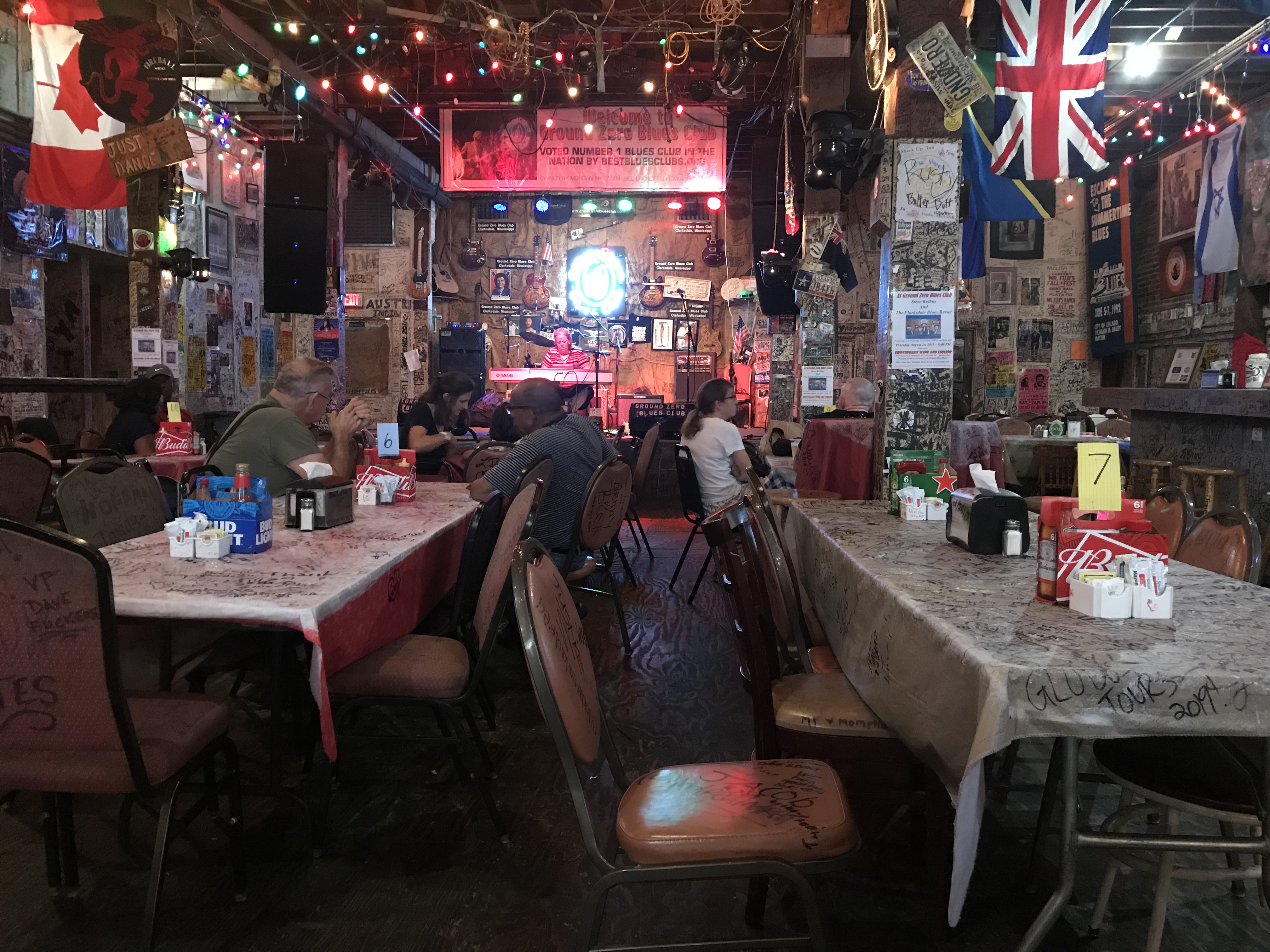
In 2001 the actor Morgan Freeman, who lives in the area, opened Ground Zero Blues Club with the entertainment executive Howard Stovall and the businessman Eric Meier. They took a cotton and grocery warehouse that had sat empty for thirty years and left it almost exactly as they found it: mismatched chairs, Christmas lights, a floor that has heard a hundred thousand feet, and graffiti climbing every wall. It was not a recreation of a juke joint. It was built to feel like the ones that were already here, and it put Clarksdale on the map for travelers who would never have found Red’s on their own.
Then, in 2002, a marketer named Roger Stolle did something that sounds like the setup to a blues song: he quit a comfortable corporate job, moved to a town some people were calling dead, and opened a store to sell the blues. Cat Head Delta Blues and Folk Art, on Delta Avenue, became the town’s unofficial visitor center, its record shop, its folk art gallery, and its clearing house for who is playing where tonight. Stolle and a local property owner named Bubba O’Keefe, who had been buying up empty downtown buildings since 1999 and restoring them at real financial risk, would sit and brainstorm how to bring the town back through the one thing it had that nobody else did.
On January 28, 2004, O’Keefe walked into Cat Head and proposed a festival. The idea was not a slick tourism product but the opposite: celebrate the actual juke joints, the informal Black music venues that had always been scattered across the Delta, and invite the world into them for a weekend. The first Juke Joint Festival ran that spring. It has grown every year since.
What it created
The numbers now tell a story that would have sounded absurd in 2000. The Juke Joint Festival draws more than 7,500 visitors each April, from all fifty states and dozens of countries, and for that one weekend it becomes the single biggest business week of the year for Clarksdale. Hotel rooms in and around town book up as much as two years in advance. The Sunflower River Blues and Gospel Festival in August, older than the Juke Joint and free to attend, brings its own crowd to the same streets around the museum.
The revival is visible block by block. Where Roger Stolle found mostly empty storefronts in 2002, downtown Clarksdale now holds working restaurants, galleries, live music venues, and lodging. O’Keefe’s restorations turned failing buildings into the Travelers Hotel, the Hambone gallery, the Stone Pony, Yazoo Pass, and more. There are at least thirty five overnight apartments downtown and the twenty room Travelers Hotel where there had been vacancy. Visitors who want the deepest version of the experience drive three miles out to the Shack Up Inn on the old Hopson Plantation and sleep in a restored sharecropper shack, air conditioning and indoor plumbing added, the weathered wood left alone. Down an unmarked side street, Red’s juke joint keeps doing what it has always done, and has become a required stop for blues pilgrims from around the globe precisely because nobody dressed it up.
That is the whole engine, and it is worth being honest about what it is and what it is not. Clarksdale in 2026 still carries a poverty rate above forty percent, one of the highest of any city in Mississippi, with a median household income around 36,000 dollars, well below the state and national figures. The population is still slowly falling. Blues tourism has not erased any of that. What it has done is give a struggling town one genuine economic engine that runs on something it already owned, could never lose to a lower bidder, and did not have to invent.
It is worth sitting with the ethics of that bet, because heritage tourism in a poor place is not a clean transaction. The blues was created by Black musicians whose descendants make up most of Clarksdale, and much of the tourism it now supports is run by, and sold to, outsiders. Done carelessly, that can slide into extraction all over again, the town’s culture packaged and shipped out while the people who carry it see little of the return. Clarksdale’s better instincts have pushed the other way. The Delta Blues Museum runs an arts and education program that puts instruments and instruction into the hands of local children, so the next generation of players comes from here rather than merely performing for visitors. Red’s stays Red’s, owned and run in the neighborhood, not bought and themed. The festival is built around the real venues and the working musicians rather than a corporate stage. None of that resolves the tension, but it points at the only version of heritage tourism that lasts: one where the tradition stays in local hands and the visit funds the thing it came to see.
Why other towns should follow Clarksdale’s lead
Clarksdale is not a place that manufactured an attraction. It is a place that finally valued the one it had been sitting on for a century, and then did the patient, unglamorous work of protecting it: a museum before there was an audience, a club that refused to be polished, a store run by a true believer, a festival built around the actual venues instead of a fenced off fairground, and a handful of people willing to buy the empty buildings and wait. The lesson is not that every town has a blues. It is that the most durable anchor a town can build is the true one, the thing that is already part of who the place is, presented with respect instead of packaging.
The economics of heritage tourism in a poor town are not simple, and Clarksdale does not pretend otherwise. Authenticity is fragile; the moment a juke joint becomes a set, the reason people came is gone. But handled with care, a living tradition is the rarest asset in tourism, because it cannot be built by a competitor with a bigger budget. Clarksdale kept the tradition alive, opened the door, and let the world come to the Crossroads. For a study of what a genuine, singular anchor can do for a small town economy, it stands alongside our flagship look at Thomas Dambo’s trolls in Detroit Lakes: two very different anchors, one shared idea. Give people a reason to come that exists nowhere else, and they will drive past a hundred exits to reach it.