How Cawker City earned the score
Population 457 (US Census 2020), less than half the 1,039 the town recorded at its 1880 peak.
Situation A farm and lake town on US Highway 24 in north central Kansas with a weathered main street and one object almost every American has heard of.
Action Farmer Frank Stoeber began winding leftover baler twine on Christmas Eve 1953. The town brought the ball downtown for the 1961 Kansas centennial, sheltered it, and has kept winding it larger every August since 1982 at a community Twine-a-thon.
Result More than 27,000 pounds and 8.5 million feet of sisal, about 200 visitors a day in peak season, and the highest per capita tourism impact in its corner of Kansas, in a town with almost nowhere to spend the night.
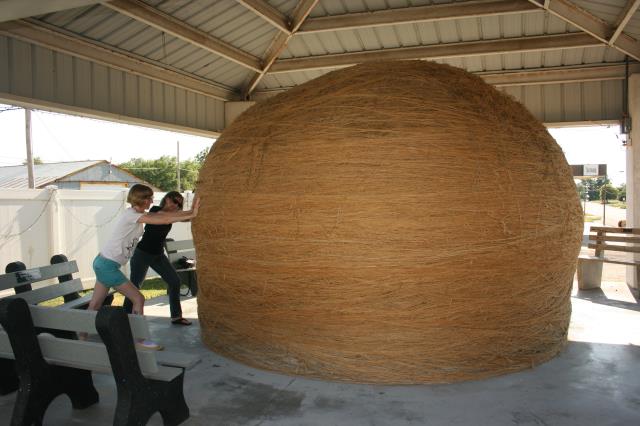
Let’s meet Cawker City, Kansas
Cawker City sits on US Highway 24 in Mitchell County, north central Kansas, along the north shore of Waconda Lake. The 2020 Census counted 457 people, and that number matters to this story twice. It makes Cawker City one of the smallest towns in this study, and it is less than half of the 1,039 residents the town recorded in 1880, its first census and its best one. This is a place that has been easing downhill, gently and without drama, for a hundred and forty years. Even the name is a wager: local history says E.H. Cawker won the right to name the town in an 1870 poker game.
None of that is why you have heard of it. You have heard of it because of a ball of sisal twine, about fourteen and a half feet across, forty six feet around at its equator, and more than 27,000 pounds, resting under an open air gazebo on the highway through town. It is the World’s Largest Ball of Twine, or one of them, and the argument buried in that phrase turns out to be part of the marketing. Kansans voted it one of the 8 Wonders of Kansas. The Kansas News Service put its length in more useful terms: unrolled, the twine would stretch from Cawker City to Long Island.
What separates this ball from every other record object on the American roadside is simple, and it is the whole case study. The ball is not finished. It will never be finished. The town decided that on purpose, and has kept the decision for more than forty years.
How Cawker City found its thing

On Christmas Eve 1953, a farmer named Frank Stoeber got tired of the loose baler twine piling up on his barn floor. He was 62. Burning it was work; winding it was tidier. So he rolled a ball, and then he kept rolling it, as Roadside America tells the story. Within three years the ball stood seven feet tall and weighed two tons, and neighboring farmers had started hauling their own spent twine to the Stoeber place rather than burning it themselves. Stoeber logged every contribution in a notebook, name by name. That detail tells you something about the man, and in hindsight it tells you what the ball was becoming. It was a community ledger before it was ever an attraction.
By 1961, the year Kansas turned one hundred, the ball was locally famous enough to ride in the centennial parade, and the town’s commercial club persuaded Stoeber to leave it downtown. In 1962 Cawker City poured a concrete slab beside US 24 and raised a shelter over it. Guinness listed the ball as the world’s largest in 1973. Stoeber died the following year, having wound roughly 1.6 million feet of twine into a sphere eleven feet across.
Most roadside origin stories end right there, with the founder’s death, a plaque, and a slow fade. Cawker City made a stranger and better choice.
How Cawker City built it: the town that keeps winding
In 1978 Guinness demoted Cawker City to second place. A retired farmer named Francis A. Johnson of Darwin, Minnesota, who had been winding four hours a day since 1950, had passed Stoeber’s mark. Cawker City’s answer was not a protest. It was a redefinition. If Darwin had the biggest ball one man could wind, Cawker City would have the biggest ball a town could wind. In 1982 the community began an annual winding festival, now the Twine-a-thon, held during the Cawker City Picnic on the third weekend of August, at which residents and any visitor who happens through walk slow loops around the sphere, feeding fresh sisal onto the surface.
The 2025 edition looked like this: winding began at 7 pm on a Friday in mid August with live music by Taylor Kline, a golf cart poker run staged from the fitness center, food trucks, and snow cones, all organized by the Cawker City Community Club. That is the entire production. No gate, no ticket, no sponsor stage.
Between festivals, the ball runs on an honor system supervised by a one woman visitor bureau. Linda Clover, the school librarian, has been the ball’s volunteer caretaker for more than two decades. She keeps spools of sisal in the trunk of her car, and when a vehicle with out of state plates rolls up to the gazebo she walks over and hands the driver a length to wind on. She logs every foot added. The Wall Street Journal once called her the belle of the ball, and her name tag now says so. “I call myself the crazy twine lady,” she told the Kansas News Service in 2022. “I have had people so excited … they could hardly wait for the car to stop so they could come and see it.”
The arithmetic of all this patience deserves a paragraph of its own. Stoeber wound 1.6 million feet in twenty one years. By 2006 the ball held 7.8 million feet. By September 2009 the Kansas Sampler Foundation logged it at 7,974,454 feet and 19,198 pounds. By March 2025 the sign at the gazebo read 8,507,430 feet and more than 27,000 pounds, which the Kansas News Service translates to the mass of five pickup trucks. Put plainly, the town and its visitors have wound more than four times as much twine as the founder ever did. The record stopped being Frank Stoeber’s a long time ago. It belongs to everyone who ever pulled off the highway and took a turn.
Four balls of twine, one argument
Cawker City’s superlative comes with asterisks, and the town is admirably relaxed about them. Darwin, Minnesota still displays Francis Johnson’s ball, twelve feet across and 17,400 pounds, in its shelter near the town park, and claims the largest ball wound by a single person. Johnson’s ball held the Guinness title from 1979 to 1994 and earned the town a Weird Al Yankovic song. A Texan named J.C. Payne wound a ball of nylon twine to a 41.5 foot circumference, certified by Guinness in 1993 and now displayed at a Ripley’s museum in Branson, Missouri. And in Lake Nebagamon, Wisconsin, James Frank Kotera wound what he reported as 24,160 pounds of twine between 1979 and his death in 2023. Four claimants, four carefully worded titles, one long running American argument.
Cawker City’s precise claim is the largest community wound ball, with the greatest circumference and the most feet of twine of any of them. But precision rather misses what the rivalry is for. The argument itself is the marketing. It has kept the phrase “world’s largest ball of twine” alive in road trip culture for half a century, in cartoons, sitcoms and license plate games, and Cawker City is the only claimant where the answer to the visitor’s first question, is it still growing, is yes. On purpose. Every August.
What the ball actually does for a town of 457

Now the numbers, because the warm story has hard edges worth measuring. In peak summer season the ball draws about 200 travelers a day, per Kansas News Service reporting, into a town of 457. The guest book collects signatures from Oregon, Florida and Italy in the same week, and over the years from Antarctica and Mongolia. Tourism’s annual per capita economic impact in Mitchell County runs $1,425, far ahead of the neighboring counties: Jewell at $655, Lincoln at $520, Ottawa at $422. For a rural Kansas county with one true attraction, that spread is the ball’s signature, visible from a spreadsheet.
Downtown has organized itself around the object as best a tired main street can. A local artist painted some fifty reproductions of famous works, the Mona Lisa, American Gothic, The Scream, Starry Night, each with a ball of twine worked into the scene, and the paintings hang in storefront windows along Wisconsin Street, so the walk to the ball doubles as an art walk. A painted twine line runs down the sidewalk to lead you there. In 2021 Matt and Julie Alford opened Eyegore’s Curiosities and Monster Museum a few doors from the gazebo, a cabinet of curiosities with a Fiji mermaid and a wall of vintage monster toys, which gives the town a genuine second reason to stop. Five miles east, Glen Elder State Park wraps the shoreline of Waconda Lake with campsites, cabins and a marina, plus a replica of Waconda Springs, the mineral spring the reservoir submerged. The pieces of a half day exist here. The town just has not strung them together, which is a sentence Cawker City of all places should appreciate.
The fifteen minute problem
Here is the honest part, and the reason the composite lands at 47. The ball is a fifteen minute experience. It is a very good fifteen minutes. You park for free, you circle the sphere, you read the hand lettered sign, Linda Clover may appear with a spool, you wind a length, you sign the book, you take the photo. Then you are done, and the town has almost no way to hold you. Lodging in Cawker City amounts to a guest house and a mini motel inside a remodeled 1930s gas station across the street from the ball. There is no hotel. Dining is a coffee shop and whatever is open on the highway. The state park takes the campers, and the larger towns down US 24 take the room nights. Between the art walk frames, storefronts stand empty, and photographs of Wisconsin Street show more plywood than glass on the upper floors.
None of this is a moral failing. It is what a century of farm consolidation does to a town of 457, and Cawker City has answered it with more wit per capita than almost any town in this study. But a Visitor Impact Score measures conversion, not wit. Two hundred people a day who each spend fifteen minutes and a few dollars are a beloved tradition and a thin economy. The contrast case in our files is Detroit Lakes, Minnesota, where Thomas Dambo’s troll trail was paired from day one with beds, restaurants and a programmed season, so the icon converts into overnight stays. Cawker City has the icon, and it has had it longer than almost anyone. Nearly everything downstream of the icon is still missing.
What comes next for Cawker City
The encouraging part is that the town’s next moves do not require a benefactor or a bond issue. The Twine-a-thon already proves Cawker City can stage a date and draw a crowd; the open question is whether one Friday evening can become a full weekend, with the lake five minutes away doing the heavy lifting on stays. The art walk already proves the town can dress its vacancies with charm; the same instinct, pointed at one or two more storefront businesses like Eyegore’s, compounds quickly at this scale. A town of 457 does not need a hundred new visitors to notice the difference. It needs twenty of the existing two hundred to stay for dinner.
And the ball keeps doing its quiet, patient work. Every August it gets a little bigger. Every visitor who winds a length becomes a contributor, and every contributor has a standing reason to come back and see what their twine became. Not many towns of any size own a ritual like that.
Why other towns should study Cawker City
Strip away the kitsch and Cawker City demonstrates something subtle: participation beats spectacle. Frank Stoeber’s twine ball was an accident of thrift. The town’s follow through was a decision, renewed annually since 1982, to take a finished object and refuse to let it be finished. That single move turned a monument into a membership, and it is why this ball still matters while most roadside giants of its era are rust and postcards. The lesson for any small town holding one odd asset is to find the Twine-a-thon hiding inside it, the repeatable public act that lets a visitor add to the place instead of just looking at it.
The second lesson is the sober one, and it is what the score prices. An icon without beds, without dinner, without a second hour of things to do, converts fame into fifteen minutes. The World’s Largest Ball of Twine made Cawker City permanent. It has not yet made it a destination. The town keeps winding anyway, one August at a time, which is exactly why it is worth watching.