Population 470 (US Census 2020)
Situation Rothsay is the Prairie Chicken Capital of Minnesota. One of the largest concentrations of the bird can be found on the meadows in the Rothsay region. Prairie chickens are famous because they.
Action Built a single roadside icon (the prairie chicken statue) into the town brand.
Result not reported
Let’s Meet Rothsay, Minnesota
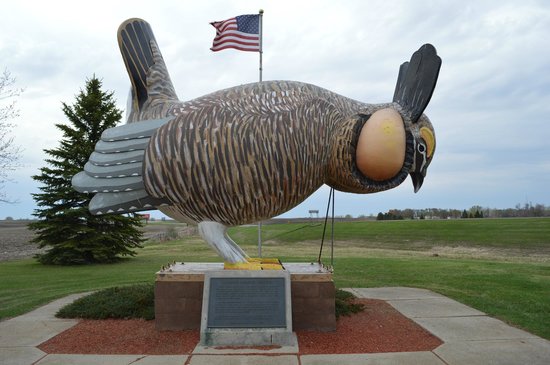
Rothsay is a 498-person city in western Minnesota, split between Wilkin and Otter Tail counties, with a single off-ramp on Interstate 94 between Fergus Falls and Moorhead. The town is 0.86 square miles in total area. There is one motel, two gas stations, a blacksmith shop on the National Register of Historic Places, and a fifteen-foot, nine-thousand-pound sculpture of a male greater prairie chicken doing its courtship dance with its yellow neck sacs inflated. The sculpture is officially the World’s Largest Booming Prairie Chicken per the World Record Academy, and it is on every Roadside America and Atlas Obscura list in the upper Midwest.
This case study is not about a town that figured out tourism. It is about a town that planted a single odd object next to the freeway in 1976 and got fifty years of brand value out of it on essentially no operating budget. The Roger-Brooks tingle on a 498-person Minnesota town is muted by the lack of supporting infrastructure, but the underlying idea, an object so specific and so weird that it carries the town’s name on its own, is worth studying.
History
The town’s name comes from Rothesay, on the Isle of Bute in Scotland. A post office named Rothsay has been in operation continuously since 1880. The settlement grew up along the Northern Pacific Railway corridor that runs through western Minnesota toward Fargo. Wilkin and Otter Tail counties are on the eastern edge of the Red River Valley, and the surrounding landscape is the tallgrass prairie that once covered most of the state. The greater prairie chicken (Tympanuchus cupido pinnatus) was, for several centuries, one of the indicator species of that landscape; it requires open grassland for its annual lek courtship dance, and the conversion of prairie to row crops across the upper Midwest has reduced the bird’s range dramatically since the early twentieth century.
Rothsay was incorporated as a city under Minnesota’s standard municipal code. The town’s one National Register-listed property is the J. A. Johnson Blacksmith Shop, a 1903 building that anchors the local historical inventory. Population peaked modestly in the early twentieth century and has hovered between 400 and 500 residents for several decades; the 2020 census recorded 498 and the 2021 estimate was 491.
The story this case study turns on starts with two dates. On June 10, 1975, the Minnesota state legislature designated Rothsay as the official “Prairie Chicken Capital of Minnesota.” The designation reflected the fact that the surrounding meadows of Wilkin and Otter Tail counties still support active prairie chicken leks each spring; the Nature Conservancy’s Bluestem Prairie Scientific and Natural Area and several other state Wildlife Management Areas in the region are among the better remaining habitats in the state. The state designation gave Rothsay a brand. The 1976 United States Bicentennial gave the town a deadline.
Rothsay’s Creative City Development
The local artist Art Fosse spent the run-up to the Bicentennial designing and building, with community labor and donations, a roughly 13-foot-tall, 9,000-pound sculpture of a booming male prairie chicken. The sculpture sits on a low pedestal in a small wayside rest just off Interstate 94, with interpretive signage explaining the booming behavior and the bird’s role in prairie ecology. The Bicentennial drove a wave of similar roadside sculpture projects across small-town America in 1975 and 1976. What separates Rothsay’s chicken from most of those is that it has stayed on the road, in good repair, for fifty years, and that it earned a World Record Academy certification as the world’s largest booming prairie chicken sculpture in 2024.
The wayside and the two gas stations
The sculpture’s economic effect is concentrated on two businesses: the two gas stations that sit at the I-94 interchange. Travelers on the Fargo-Twin Cities corridor who pull off to photograph the chicken almost always buy gas or food. The chicken is not, on its own, a destination. It is what tourism marketers call an inducement; it converts a routine bathroom stop into a longer, higher-spend stop. The TripAdvisor rating for the statue sits at 3.9 over 42 reviews; the language in the reviews uses “quirky,” “fun,” “must-see,” and “icon” repeatedly. The Comfort Zone Inn, an 11-room motel and the only lodging property in town, rates 4.3 over 17 reviews. There are no bookable experiences in Rothsay; the statue is free, walk-up, twenty-four-hour access.
The recurring events
Rothsay runs three small annual recurring events. Prairie Days is a three-day June festival with a parade, a 5K, and vendor booths. Boomer’s Bash, named for the booming prairie chicken, is a one-day community event tied to the city calendar. The Rothsay Round-Up Rodeo is an annual recurring event listed on the city’s calendar. The combined event volume is real but small relative to comparable peer towns; the case study scoring credits Rothsay with three recurring return drivers, which is the lower bound on the VIS rubric.
By the Numbers
The 2026 Visitor Information Score for Rothsay came out at 40.2 of 100, F grade, with a 1.12 uniqueness multiplier. The category leader was Brand at 59.7; the laggard was Anchor at 5.0. The Anchor score is low because a roadside statue with no bookable component, no guided programming, no merchandise tied to the visit, and no overnight package scores near the floor of the VIS rubric for that category. The town does well on uniqueness: the prairie chicken is genuinely one of a kind, the search term resolves cleanly, and the icon is recognizable in the regional outdoor and roadside-travel media. It does poorly on Stay (19.4) because there is one motel and no promoted lodging packages, and moderately on Web (48.5) because rothsay.gov is a city government site, not a tourism portal, and returned a 403 when checked in late May 2026. The composite is not flattering, but it is honest: Rothsay has a strong icon and effectively no visitor infrastructure built around it.
Community Benefits
The benefit is modest and durable. Two gas stations are still in business because the chicken stops the cars. A small motel survives. The town’s brand identity, which is the rare thing you cannot buy in a 500-person community, is permanent. The risk in the model is that without continued investment, the asset slowly fades; a comparable town eleven miles up the road, Pelican Rapids, has Pelican Pete and a more developed downtown to back him up. Fergus Falls, twenty minutes east, has a Minnesota-shaped swimming pool. Rothsay’s chicken is the strongest of the three icons in isolation but the weakest at converting traffic into spending.
Why Other Towns Should Follow Rothsay’s Lead
The lesson from Rothsay is the smallest one in this field study, but it scales. A 500-person town can have a brand. The brand has to be specific, weird, well-named, and physical. The execution does not need to be expensive. Art Fosse and a Bicentennial committee built the chicken with donated materials and local labor. Fifty years later it still pulls travelers off a divided highway. The cautionary half of the lesson is the half Rothsay has not yet acted on: a brand without infrastructure plateaus. The next move for towns running the Rothsay play is to build a bookable thing, a recurring event, a lodging package, or a merchandise line that takes the icon and turns it into an actual visit. Without that step, the statue stays a postcard. With it, the town gets a tourism economy.