How Half Moon Bay earned the score
Population 11,795 (US Census 2020), the oldest town in San Mateo County, about forty minutes south of San Francisco.
Situation An agricultural coast community near a major metro, with farms, a fishing harbor, and no single reason for a city visitor to make the drive.
Action Turned one seasonal crop into an October festival and one offshore wave into a world-class surf identity, then let a luxury resort and a working harbor carry the rest of the year.
Result A festival drawing more than 200,000 people over one weekend, a pumpkin weigh-off that makes national news every fall, and hotel-tax revenue near 9.9 million dollars that funds roughly 40 percent of the city budget.
Let us meet Half Moon Bay, California

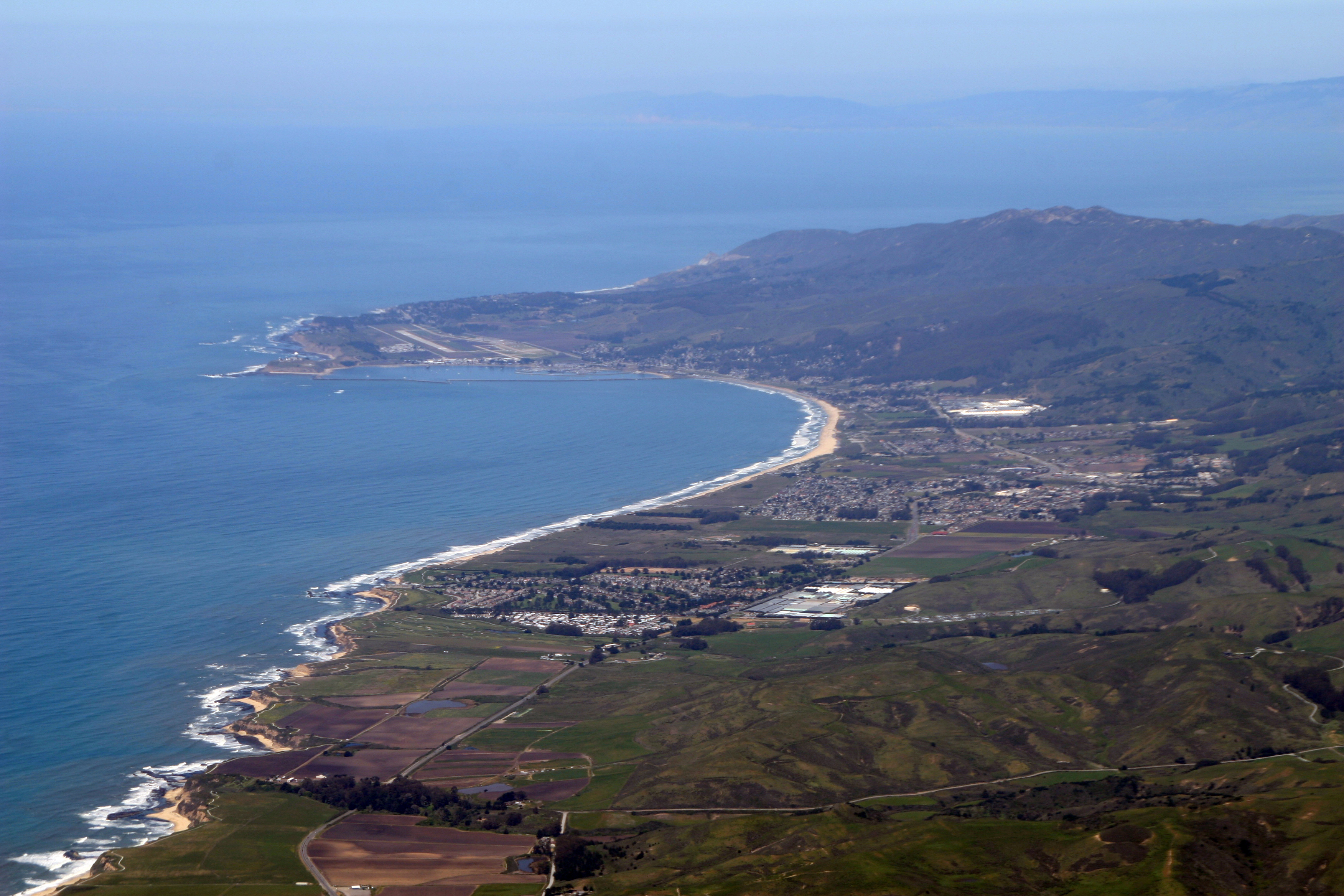
Half Moon Bay sits on the San Mateo County coast, about twenty five miles and forty minutes south of San Francisco, at an elevation of seventy five feet where the hills drop to the Pacific. It is a small place, 11,795 people at the 2020 census across roughly six and a quarter square miles, and it is the oldest town in the county. The community grew up in the 1840s, first called San Benito, then Spanishtown as a mixed fishing and farming settlement of Portuguese, Italian, Mexican, Chinese, Irish and other families, and it was officially renamed Half Moon Bay in 1874. It incorporated as a city on July 15, 1959.
For most of its life the town did what coastal California towns do. It farmed. The cool, foggy, mineral rich air off the water is close to perfect for a short list of crops, and Half Moon Bay grew them well: artichokes, beans, Brussels sprouts, cut flowers, nursery houseplants, Christmas trees, and pumpkins. The 1950s brought frozen food companies to the coast to buy the Brussels sprouts. The nurseries and flower farms became a regional supply. None of that, though, is the kind of thing that makes a family in Palo Alto or Oakland decide to spend a Saturday driving over the hill. A working farm town near a big city is easy to drive past. The question for Half Moon Bay, the question this case study is really about, was how a place like that gives a metro a reason to stop.
How the town found its thing
The answer started with a problem on Main Street. By 1971 the historic downtown was beginning to look tired, and a group of residents formed the Main Street Beautification Committee to raise money to fix it up. They looked around at what they had, which was pumpkins, everywhere, in the fields at the edge of town every October. So they threw an old fashioned harvest festival to raise the money. The first Half Moon Bay Art and Pumpkin Festival, in 1971, drew about 30,000 people. That was the whole idea at the start: a fundraiser to pay for streetlights and a nicer downtown, built on the one thing the town already had in abundance.
The title came three years later, and it came from a fight. In 1974 Frank Barnhill, then the mayor of Circleville, Ohio, visited Half Moon Bay and was struck by how seriously the coast took its pumpkins. Circleville also called itself the Pumpkin Capital of the World, and so did Half Moon Bay, and the two towns agreed to settle it. They hauled their biggest local gourds to their respective city halls for a head to head weigh-off. Half Moon Bay won by a single pound. Its champion was a 132 pound pumpkin grown by a local named John Minaidis. On that one pound margin, Half Moon Bay claimed the title of Pumpkin Capital of the World, and a rivalry became a tradition.
How it built it
What Half Moon Bay did next is the part other towns should study. It did not treat the festival and the weigh-off as a one time stunt. It committed to them, every year, for more than half a century, and it let them grow into something bigger than either the town or the vegetable.
The festival matured into a two day event held on the weekend after the second Monday in October, with roughly 250 artists and craftmakers, dozens of local nonprofit groups running the food and game booths, live music, a costume contest, and the pumpkins at the center of all of it. Crucially, the money kept doing civic work. Over the decades, festival proceeds paid for the construction of two parks, multiple scholarship funds, the old fashioned streetlights that started the whole thing, the undergrounding of the Main Street utility wires, and a renovation of City Hall. The festival was never only marketing. It was a fundraising engine pointed back at the town that hosts it, which is a large part of why residents kept showing up to run it.
The weigh-off, meanwhile, turned into a genuinely national spectacle. What began as a 132 pound grudge match against Circleville is now the Safeway World Championship Pumpkin Weigh-Off, held the Monday before the festival, and it is treated as the Super Bowl of giant pumpkin growing. Serious growers truck their gourds in from across the country and beyond. The winning pumpkins grew heavier every decade, past a thousand pounds, then past two thousand. In 2023, at the fiftieth annual weigh-off, Travis Gienger of Anoka, Minnesota set a North American record with a pumpkin weighing 2,749 pounds. He came back and won again in 2024 with a 2,471 pound entry, and in 2025 Brandon Dawson of Santa Rosa took the title with a 2,346 pound gourd. The prize is built to make the front page: the champion earns nine dollars a pound, topped up to a guaranteed thirty thousand dollars for a new record. Every October, the photographs of a two thousand pound pumpkin on a scale in a small California town go out on the wires, and the town gets its name in the news for free.
The second asset, out past the harbor
A festival is a weekend. What separates Half Moon Bay from a town with one good event is that it also sits next to a world class natural asset, and that asset costs the town nothing to own. About a half mile off Pillar Point, just north of downtown near the harbor community of Princeton-by-the-Sea, is Mavericks, one of the most serious big wave surf breaks on the planet. After a strong North Pacific winter storm, the wave routinely stands over twenty five feet and can top sixty. It is dangerous, cold, and famous.
The Mavericks story is largely one man’s. A local surfer named Jeff Clark first paddled out to the break in 1975, at seventeen, and then surfed it essentially alone for about fifteen years, into 1990, before the wider big wave community caught on. Clark went on to help design the four fin big wave boards that became the standard for the sport, and he founded the contest that put the break on television. The event ran under a series of names from 1999 through 2016, from Men Who Ride Mountains to the Mavericks Invitational to Titans of Mavericks. Because a wave will not perform on a schedule, the one day contest eventually gave way, and since 2019 the celebration has continued as the Mavericks Awards, a video performance contest judged from the best footage of each season, with a ceremony held in Half Moon Bay each spring. The wave draws surfers, photographers and spectators to the bluffs at Pillar Point all winter, and it gives the town a global keyword that has nothing to do with produce.
What it created
The two anchors, the pumpkin and the wave, sit on top of a real hospitality economy. The festival alone draws more than 200,000 people to a town of under 12,000 over a single weekend. That is a striking ratio, and it is only the peak. On the bluffs south of downtown, the Ritz-Carlton, Half Moon Bay opened in 2001 with two ocean golf courses along the Coastal Trail and quickly became the largest employer in the city. The town also has coastal state beaches, the Half Moon Bay State Beach among them, a stretch of the California Coastal Trail, a farmers market, and the nurseries and U-pick farms that turn the agricultural base into a visitor attraction in its own right.

The clearest measure of what all this built is the city’s own budget. Half Moon Bay is one of the rare California cities where the transient occupancy tax, the tax on hotel stays, is a larger revenue source than property tax. That tax brought in about 8.7 million dollars in 2025 and ran near 9.9 million dollars at the midpoint of the 2025 to 2026 year, and it accounts for roughly 40 percent of the city’s operating budget. The vulnerability of the model is just as clear: when travel stopped in 2020 and 2021, that same revenue fell from about 6.8 million dollars before the pandemic to roughly 2.3 million dollars, and the city felt it. A tourism identity is an asset and an exposure at the same time. The median household income here, about 153,199 dollars in recent Census estimates, reflects both the coast’s desirability and the cost of living beside a wealthy metro.
What is next
The proximity that makes Half Moon Bay work is also the thing it has to manage. Forty minutes from San Francisco is close enough to fill the festival and the hotels, and close enough that a single road over the hill can turn a big event weekend into gridlock. The town’s task now is less about inventing an identity, which it clearly has, and more about spreading the load: pulling visitors into the shoulder seasons, spring and early fall, so the whole model does not ride on one October weekend and one winter swell. The recent budget numbers, which show hotel stays rising in April and across the year rather than only in October, suggest that spreading is already underway.
Why other towns should study Half Moon Bay
Half Moon Bay ran a play that a lot of agricultural towns near cities could run. It did not import an attraction or manufacture a theme. It looked at what was already in its fields and just offshore, a common crop and a dangerous wave, and it committed to both for decades until they became a brand. It pointed the proceeds back at its own Main Street. And it let a single vegetable and a single wave give a small farm town a reason for a whole metro to make the drive. That is the entire idea behind Creative City Developments: find the real, specific, slightly strange thing a place already has, and build the welcome around it.
See the flagship Detroit Lakes case study for the same pattern run with giant wooden trolls instead of giant pumpkins.