How Skagway earned the score
Population 1,240 (US Census 2020), closer to eleven hundred year-round once summer help goes home.
Situation A remote Alaskan port at the head of Taiya Inlet, famous for the dramatic 1897 to 1898 winter when it was the gateway to the Klondike, then left with a boardwalk of gold-rush buildings and almost no other industry.
Action Preserved the boomtown intact as a National Historical Park, kept the 1898 railroad running over the pass, and pointed the whole town at the cruise ships that anchor offshore.
Result A year-round town of roughly 1,100 that hosts close to a million cruise passengers a season, swelling past 9,000 people on the busiest summer days.
Let’s meet Skagway, AK
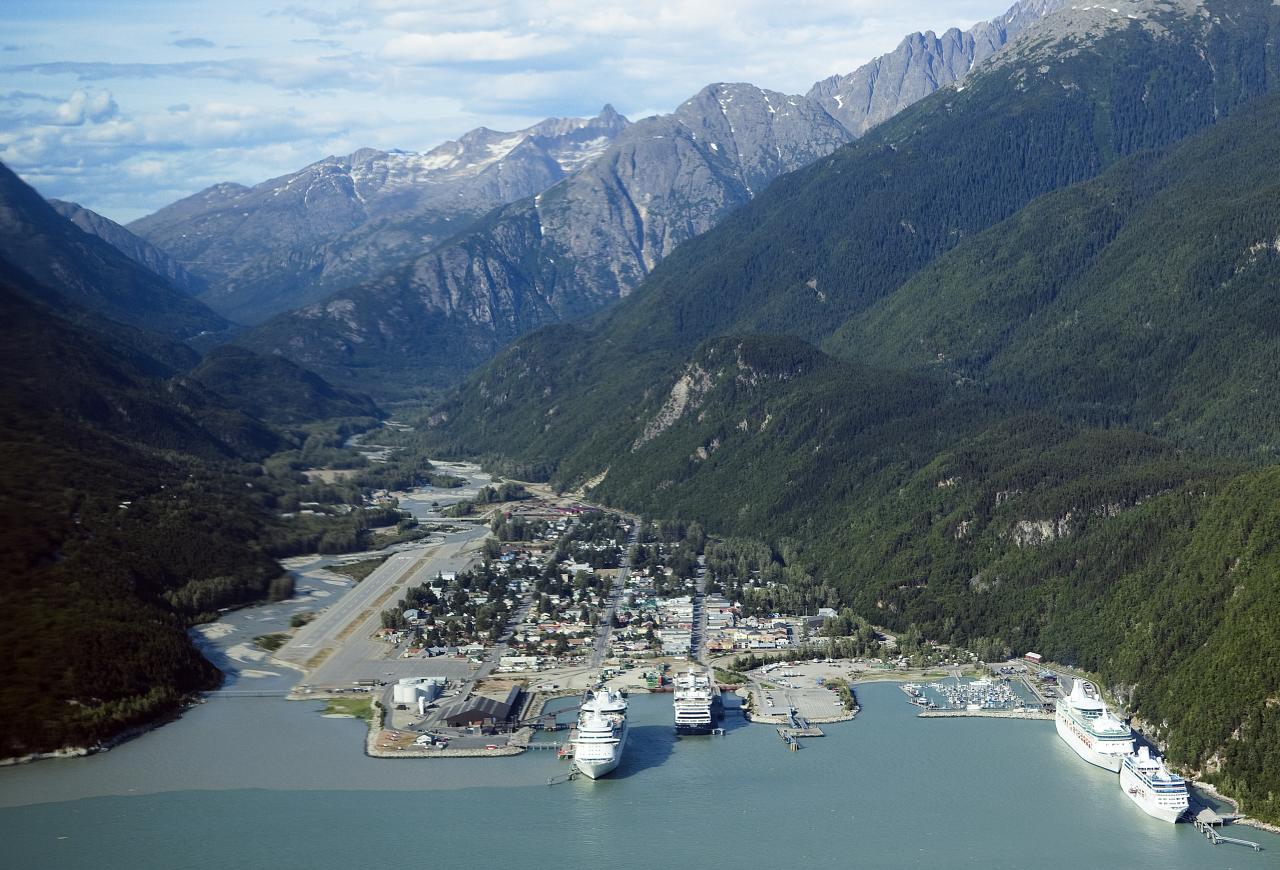
Skagway sits at the very top of the Inside Passage, at the head of a long saltwater fjord called Taiya Inlet, where the Coast Mountains pinch the shoreline down to a narrow strip of gravel. The town fills that strip and not much more. The 2020 Census counted 1,240 residents, and the year-round number sits closer to eleven hundred once the summer help goes home. It is one of the smallest incorporated places in the United States that anyone outside Alaska can name, and the reason people can name it is a single winter more than a century ago.
The land is the traditional territory of the Chilkoot Tlingit, who used the mountain passes above the town as trade routes into the interior long before any of this had a post office. The modern town owns that history openly. The Skagway Borough Assembly opens its meetings by acknowledging that it gathers on Chilkoot Tlingit land. What put Skagway on the map, though, was the way a much later crowd used those same passes, in a hurry, and mostly badly.
The year that made the town
Gold was found in the Klondike, in Canada’s Yukon, in August 1896. Word did not reach the outside world in force until the summer of 1897, when steamships docked in Seattle and San Francisco carrying miners and their gold. What followed is one of the great manias of American history. An estimated 100,000 people set out for the Klondike goldfields. Only somewhere between 30,000 and 40,000 actually got there.
Almost all of them came through here. Skagway and its now-vanished neighbor Dyea were the two main landing points, the places where a stampeder stepped off a boat and started walking. From Skagway the route was the White Pass Trail. From Dyea it was the brutal Chilkoot, the one with the famous staircase of ice steps that shows up in every photograph of the era. Neither was long, under forty miles, but neither was passable in a single trip. Canadian authorities, wary of mass starvation over the winter, required every person crossing the border to bring a full ton of supplies, about 909 kilograms of food and gear. A stampeder could carry only a fraction at a time, so most walked the trail dozens of times over, ferrying their outfit forward load by load. Many gave up at the summit and turned around.
The town they left behind them at the bottom did not turn around. By June 1898, with a population estimated between 8,800 and 10,000, Skagway was the largest city in Alaska. It was also, briefly, close to lawless.
Soapy Smith and the making of a legend
Into that boomtown walked Jefferson Randolph Smith, better known as Soapy, a career confidence man who had run rackets across the frontier. He took his nickname from an old swindle involving bars of soap supposedly wrapped with hidden cash. By 1898 he effectively ran Skagway, operating rigged games, a fake telegraph office, and a network of shills who fleeced arriving miners.
It ended on the evening of July 8, 1898, on a wharf, in a confrontation with a town vigilance committee. Smith was shot through the heart and died on the spot. Frank Reid, the city surveyor who stood against him, was shot too, and died of his wounds twelve days later. The whole affair lasted a few violent seconds, and it has been the single most valuable piece of intellectual property Skagway owns ever since. Jeff Smith’s Parlor, the saloon that served as his headquarters, still stands on Second Avenue. The National Park Service refurbished it and reopened it as a museum in 2016. The gunfight is a fixed point on the modern tourist itinerary, retold every summer to people who arrive by cruise ship on the same calendar week it happened.
One railroad over the pass

The other thing the rush left behind was a railroad. Construction on the White Pass and Yukon Route began in 1898, while the stampede was still on, and finished in 1900. Crews built it in roughly twenty-seven months using hand tools, black powder, and local timber, and they built it narrow, a three-foot gauge that could bend around the cliffs. In about twenty miles of track the line climbs nearly 2,900 feet from tidewater at Skagway to the White Pass summit on the border, one of the steepest railroad climbs in the world. The American Society of Civil Engineers and the Canadian Society for Civil Engineering jointly named it an International Historic Civil Engineering Landmark in 1994, putting it in the same company as the Eiffel Tower and the Panama Canal.
The railroad outlived its purpose almost as fast as the town did. The Klondike rush effectively ended in 1899, when gold turned up at Nome and the crowd moved on. The line carried ore and freight for decades, then shut down its through service in 1982 when the mines closed. What saved it was tourism. It reopened as an excursion railroad, and today the White Pass and Yukon Route carries roughly 300,000 passengers between May and September, which makes it one of the most heavily ridden tourist railroads in North America. It is the biggest single attraction in a town whose entire modern economy is attractions.
What Skagway built with it
Preservation is the quiet decision underneath all of this. In 1976 Congress created Klondike Gold Rush National Historical Park, and the town let the National Park Service take the boomtown seriously as a monument rather than tear it down for something newer. The park runs to 13,191 acres and reaches out to the Dyea ghost town and the Chilkoot and White Pass trails, but its heart is a six-block historic district in downtown Skagway. Roughly a hundred gold-rush-era buildings survive there. The Park Service has restored about fifteen of them and leases many back out for ordinary commercial use, so the false fronts along Broadway are not a stage set, they are working stores. The visitor center itself occupies the original 1898 White Pass and Yukon Route depot. The effect is a downtown that reads as authentic because, structurally, it is.
That authenticity is the product Skagway sells, and it sells it at a scale that is hard to picture until you see the arithmetic. The vast majority of visitors, well over a million in a strong year, arrive by cruise ship for a single day in port. More than 400 cruise-ship calls land here in a season. From mid-May to mid-September the town of roughly 900 to 1,100 year-round residents routinely swells to about 9,000 people on a busy day, and on the very busiest, with up to five ships in at once, more than 8,000 passengers, close to ten times the resident population, come off the boats and down the gangways onto Broadway. It is one of the most extreme daily multiplications of any inhabited place in the country. The town effectively rebuilds its population every morning and empties it every evening.
The numbers behind that traffic have climbed steadily. Skagway drew about 842,000 cruise passengers in 2017. It set a record near 960,000 in 2019. The pandemic erased almost all of it, and the loss was close to fatal: the municipality had counted on roughly 160 million dollars in visitor money in 2020, and when that failed to materialize the town paid stimulus directly to its own residents to keep them afloat. The rebound was fast. By 2022 the port was back to around 600,000, and 2023 was projected at 1.2 million, nearly double the year before and a new high.
A town that runs on one season
Skagway is, in the plainest sense, a seasonal machine, and it has organized nearly everything around that fact. The local sales tax is literally seasonal: 5 percent from April through September, when the ships are in, and 3 percent from October through March, when they are not. About 53 percent of the town’s summer jobs are directly visitor-related, a share far above other Southeast Alaska ports like Ketchikan at roughly 12 percent or Juneau near 9 percent. The dependence is total in a way that most tourism towns only approach. When the ships stop, as they did in 2020, there is not much underneath.
That concentration is also the town’s exposure. In 2022 a series of rockslides began battering the cliff face above the docks, closing part of the port’s berthing capacity and forcing some ships to skip the stop, which in a town like this is not an inconvenience but a direct hit to the year’s income. More recently the municipality has been fighting over money at the margins of the cruise business: an ordinance passed in December 2024 put a tax on the commissions cruise lines earn on independently run shore excursions, a measure the borough estimates is worth about 500,000 dollars a year for public services, and which the cruise industry promptly sued to stop. The through-line is a small government trying to capture a fair share of an economy that mostly belongs to companies headquartered somewhere else.
None of that has broken the underlying model, which is genuinely rare. Skagway is not a town that manufactured a festival or branded a slogan. It preserved a real place and a real story and made them legible to a million people a year who step off a ship with a few hours to spend. It is a smaller, colder, more historically loaded cousin of the play that Detroit Lakes, Minnesota ran with Thomas Dambo’s giant trolls: find the one thing only you have, commit to it completely, and let it pull visitors off the main routes and into a small community. Skagway’s one thing just happens to be an actual gold rush.
Why other towns should follow Skagway’s lead
The lesson from Skagway is not that every town has a gold rush in its past, because almost none do. It is what Skagway did with the one it had. It refused to let the boomtown rot or be replaced. It kept a hundred-year-old railroad running for no reason except that people would pay to ride it. It let a con man’s death become a story worth retelling every day of the summer. And it accepted a hard bargain, a few frantic months carrying the whole year, in exchange for keeping a town alive at the top of a fjord where, by every economic logic, no town should still be. The current mayor, Orion Hanson, presides over a place that empties and refills like a tide. That it works at all is the case study. Pick the one thing that is only yours, protect it honestly, and build the season around it.