How Cody earned the score
Population 10,028 (US Census 2020), seat of Park County, Wyoming, in the Bighorn Basin, 52 miles east of Yellowstone’s East Entrance.
Situation In 1896 the most famous entertainer on earth put his own name on a sagebrush townsite and promoted it exactly the way he promoted his Wild West show. Cody is the rare American town founded as a production, and it has stayed in show business for 130 years.
Action Buffalo Bill lobbied a railroad into town, built the grandest hotel in the Rockies and named it for his daughter, pushed for a dam that was the tallest in the world when finished, and sold the 52 miles to Yellowstone as the scenic way in. After he died, the town institutionalized the act: a memorial association within seven weeks, a Stampede since 1919, a rodeo every summer night since 1938.
Result Direct travel spending of 519 million dollars a year in Park County, 2.747 million overnight visitor nights, about 4,230 travel supported jobs, nearly one in five in the county, and a nightly rodeo that has sold as many as 93,460 seats in a season.
Situation: the town a showman founded as a show
At eight o’clock on any summer night, under the lights at Stampede Park on the west edge of town, a bareback rider nods and a gate swings open. It has happened every single night, June through August, since 1938. The Cody Nite Rodeo is the longest running nightly rodeo anywhere, the reason this town of 10,028 calls itself the Rodeo Capital of the World, and the least surprising thing about the place once you know who founded it.
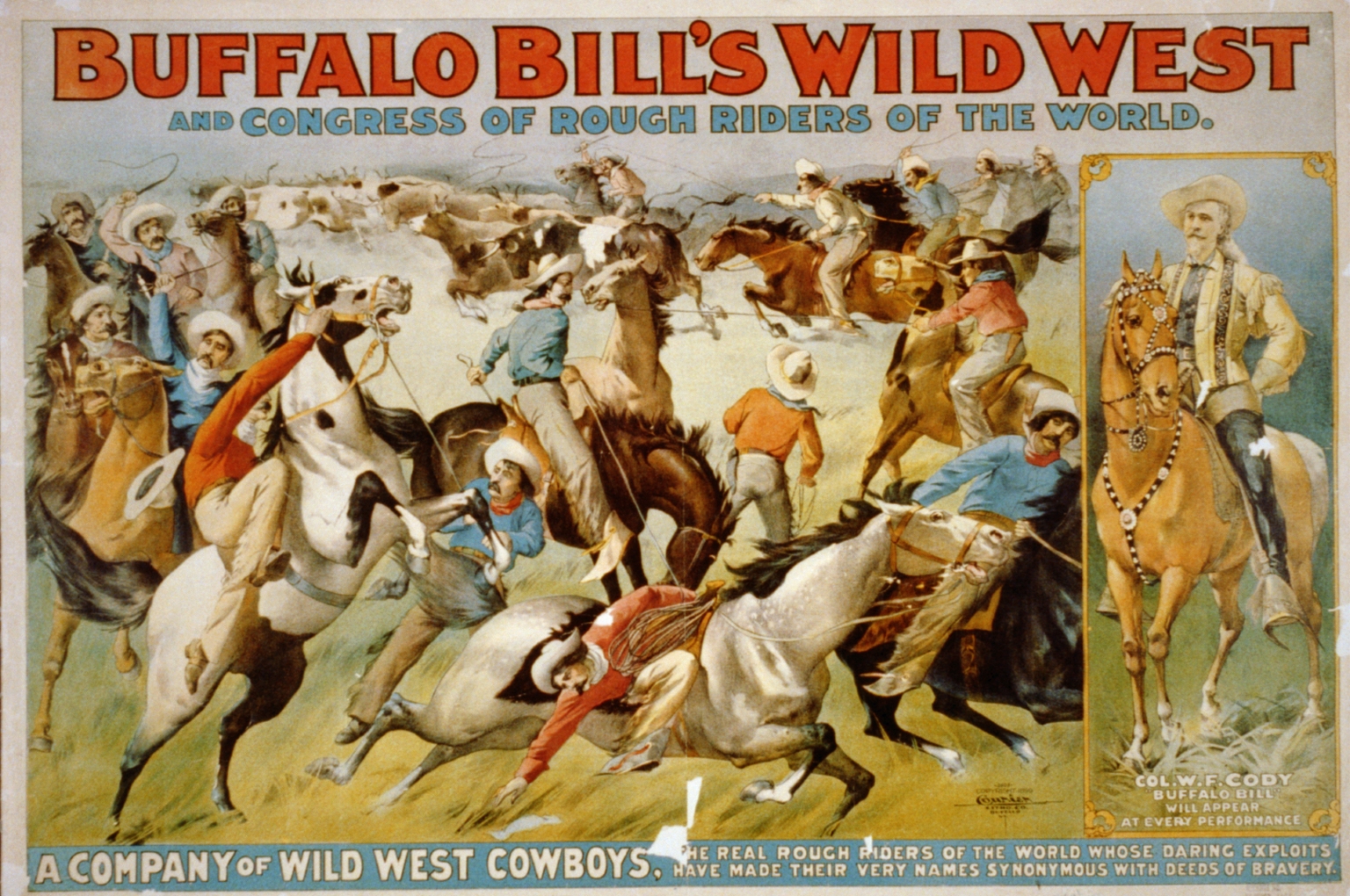
Most towns in this series stumbled into their thing: a groundhog, a waterpark, a troll in the woods. Cody was built on purpose, by the one man in America best qualified to build it. In 1896, William F. “Buffalo Bill” Cody joined a group of Sheridan businessmen planning a settlement in the empty Bighorn Basin, and his Shoshone Irrigation Company, run by George T. Beck, platted the townsite that took his name. The founder was not a land speculator dabbling in fame. He was fame. His Wild West show, launched in 1883, had performed for Queen Victoria in her Jubilee year of 1887 and would tour Europe eight times. When he staked the town, he was arguably the most recognizable living human being on the planet.
So Cody, Wyoming began life less like a homestead and more like a production: a famous name above the title, a set still under construction, and an audience that had to be transported in. The 2020 census counted 10,028 residents. The show they inherited has now run longer than its founder lived.
Task: build a real economy under a stage name
A celebrity name on a plat map guarantees nothing. Three problems stood between the 1896 townsite and a working town.
The stage had no audience
The Bighorn Basin was one of the emptiest corners of the lower 48, a high desert ringed by mountains. In 1900 the town held slightly more than 300 people. Any audience would have to be delivered by rail, and the nearest line was in Montana.
The desert had no water
The Shoshone Irrigation Company’s canal struggled from the start. Without water, there would be no farms, and without farms, no year round town underneath the tourism.
The show had to outlive the showman
Buffalo Bill was fifty when the town was named. The question that decides this case study is what happens to a founder-as-brand town when the founder dies, which he did, in January 1917, buried not in Cody but on Lookout Mountain in Colorado, to the town’s lasting irritation.
Action: the railroad, the hotel, the dam, and a rodeo every night
What Buffalo Bill did next reads like a checklist for manufacturing a destination, seventy years before anyone used that word. First, the audience delivery system: he pressed the Chicago, Burlington and Quincy to run a branch line into the basin, and the railroad reached Cody on November 11, 1901. The town incorporated the same year. Second, the front of house: on November 18, 1902 he opened the Irma Hotel, named for his youngest daughter, an imposing stone building in a town of wooden ones that boasted it was the most modern hotel in the Rockies and probably cost him 80,000 dollars, per WyoHistory. He owned the livery stable, the blacksmith shop, and the newspaper, and he insisted the streets be platted wide, which is why Sheridan Avenue still parades four generous lanes through downtown.
Third, the water. When the irrigation company faltered, Cody and his partners turned the project over to the new federal Reclamation Service, and between 1905 and 1910 government engineers wedged a concrete arch into the granite slot of Shoshone Canyon west of town. At 325 feet, the dam was the tallest in the world when it was finished in January 1910, cost 1.4 million dollars, and killed seven of the men who built it. It was renamed Buffalo Bill Dam in 1946. The reservoir behind it waters the basin’s farms to this day, and the visitor center on its crest is a ten minute stop on the way to Yellowstone.
Fourth, and smartest, the positioning. Yellowstone’s East Entrance sits 52 miles west of town, and Buffalo Bill promoted his namesake as the park’s eastern front door, the place where the tour begins. That claim did not depend on his celebrity to stay true. It is geography, and it still funnels traffic down Sheridan Avenue every summer morning.
The statue arrived before the museum
Cody’s memorial institutions were built in an unusual order. The bronze came first: Buffalo Bill’s niece Mary Jester Allen recruited Gertrude Vanderbilt Whitney, who had the horse Smokey shipped east from the TE Ranch to her New York studio, paid most of the roughly 50,000 dollar cost herself, and saw The Scout dedicated on July 4, 1924. The museum followed three years later in a log building modeled on Buffalo Bill’s ranch house. Whitney went on to found the Whitney Museum of American Art; her family’s money later endowed the western art museum that carries the name in Cody.
Then the founder exited and the town proved the brand could run without him. Buffalo Bill died in January 1917. On March 1, 1917, seven weeks later, the town chartered the Buffalo Bill Memorial Association. Allen opened the original Buffalo Bill Museum in 1927 and served it until 1960. From that 50 by 70 foot log cabin grew the Buffalo Bill Center of the West: five museums and a research library under one roof, more than 50,000 artifacts on a seven acre campus, and, since 2008, Wyoming’s first Smithsonian Affiliate. The Buffalo Bill Museum keeps the founder, the Whitney holds the art, the Plains Indian Museum carries the deeper history the show mythologized, the Draper covers the Yellowstone ecosystem, and the Cody Firearms Museum, rebuilt in 2019, holds the country’s most comprehensive firearms collection. Admission is good for two days, which is a quiet tell about how much is inside.
The performance calendar got the same institutional treatment. In 1919, Clarence Williams organized a rodeo for the Fourth of July, and the Cody Stampede has run every summer since, now drawing 800 to 900 professional contestants to one of the richest Fourth of July rodeos in the sport. In 1938 the town spun up the nightly version, so the visitor who missed the Stampede would still find the show on. Eighty eight seasons later it has never gone dark in summer.
Result: a century of box office, measured
Start with the county ledger. The Wyoming Office of Tourism’s latest Economic Impact of Travel report, prepared by Dean Runyan Associates, puts direct travel spending in Park County at 519 million dollars, second among Wyoming’s 23 counties and behind only Teton County, home of Jackson Hole. Visitors logged 2.747 million overnight nights, stayed 2.7 days, and spent 487 dollars per trip on average. Travel supports about 4,230 local jobs, nearly one in five in the county, 138.5 million dollars in earnings, and 25.5 million dollars in local tax receipts. For a county whose largest town holds ten thousand people, that is not a sideline. That is the economy.
The gateway does the volume. Yellowstone logged 4,744,352 recreation visits in 2024, its second busiest year ever, and the East Entrance admitted about 167,000 vehicles of that tide, the quietest of the park’s five gates. Quiet is the sales pitch: the Cody road in runs through Shoshone Canyon, past the dam, up the Wapiti valley, and the town has spent a century giving that traffic reasons to stop overnight instead of driving through. The nightly rodeo is precisely engineered for gateway economics. Spend the day in the park, be back in Cody by dinner, and at eight o’clock there is a show.

The show itself sells. When the Tate family took over the Cody Nite Rodeo, season attendance stood at 67,676; the record season, 2015, drew 93,460, roughly a thousand people in the stands on an average night, every night, for ninety nights. The Stampede stacks its 800 plus contestants on top of that each July. The Center of the West anchors the day trade; the New York Times’ critic Edward Rothstein, reviewing it, concluded that behind the mythologizing is something worth cherishing. And on the west edge of town, Old Trail Town holds the unpolished version: beginning in 1967, a local archaeologist named Bob Edgar hauled in 26 original frontier buildings dated 1879 to 1901, including cabins used by Butch Cassidy’s Hole in the Wall gang, and reassembled them log by log where the original Cody townsite was staked.
Reading the founder honestly
Cody the town does not pretend Cody the man was a simple hero, and the scorecard rewards the honesty. The Plains Indian Museum, developed with Native advisors, sits in the same building as the founder’s saddles and show posters, and it draws its own scholarship and its own visitors. A founder-as-brand town that lets the complicated parts of the founder’s story stand alongside the legend ages far better than one that laminates the myth, because journalists, teachers, and repeat visitors all need something true to come back to.
Takeaway: the founder is the brand, the schedule is the moat
Cody’s lesson is not “be founded by a celebrity,” which no town can order up. It is what the town did with the head start. It converted fame into infrastructure while the fame was alive: a rail line, a grand hotel, a federal dam, a road to the park. It institutionalized the brand within weeks of the founder’s death, handing it to an association, then a museum, then five. And it understood that a claim like Rodeo Capital of the World is not a slogan but a service level: the town has honored an every-single-night promise since 1938, and that reliability, more than any billboard, is what turns a pass-through gateway into a two night stay.
The pattern rhymes with what Detroit Lakes, Minnesota is building with its Thomas Dambo trolls, a case we covered in our Detroit Lakes report: an icon brings the visit, and programming decides how much of the visit the town keeps. Cody simply started the clock 130 years earlier, with a founder who understood better than anyone alive that the show does not run itself. You build the venue, you print the schedule, and then, every night at eight, you open the gate.