How High Point earned the score
Population 114,059 (US Census 2020)
Situation High Point is the Home Furnishings Capital of the World, a city organized almost entirely around the twice yearly High Point Market. Between markets, the showroom district goes quiet and there is little for a casual visitor to do.
Action The city added a public, free, family scale leisure attraction, Little Sally, an eighteen foot Thomas Dambo troll unveiled in November 2025 as part of the largest Dambo installation in the United States.
Result In roughly eight weeks Little Sally drew more than 31,000 visitors from 41 states, a genuine B2C draw for a town built for B2B.
Meeting High Point
High Point is a city of 114,059 people in the Piedmont Triad of North Carolina, spread across four counties with most of it in Guilford. It is the ninth most populous city in the state, and for most of the country it is known for one thing. High Point makes and sells furniture. The city calls itself the Home Furnishings Capital of the World, and unlike a lot of civic slogans, that one is close to a plain description of what the place does.
The name is older than the furniture. When the legislature approved a plank road from Fayetteville to Salem and a railroad from Goldsboro to Charlotte in 1849, a town grew up where the two crossed. It took its name from being the highest point on the North Carolina Railroad’s surveyed line, an elevation figure usually given as 939 feet. The town was incorporated on May 26, 1859. The furniture came a generation later. The first furniture factory opened in 1888, and the reasons were geographic before they were cultural. High Point sat on the rail line, with hardwood in the surrounding Piedmont and a rail connection to ship finished goods to the rest of the country.

How it built the thing
What turned a factory town into a capital was not manufacturing alone. It was the decision to become the place where the industry gathered to buy and sell. The first furniture exposition in North Carolina was held in High Point in 1905. In 1921 the city opened the Southern Furniture Exposition Building, a ten story hall of showrooms, and with it High Point replaced Chicago as the site of the nation’s most important annual furniture show. That is the move that mattered. A town that only made furniture would have risen and fallen with the factories. A town that hosted the market kept the industry’s attention even after the making moved on.
And the making did rise first. After the Second World War, by one widely cited estimate, roughly 60 percent of all furniture made in the United States was produced within a 150 mile radius of High Point. The showrooms multiplied until they had absorbed most of the old downtown. That last part is the quiet cost of the strategy, and it still shapes the city. As Wikipedia’s own entry puts it, much of downtown High Point lacks the traditional retail and restaurant businesses that characterize other large North Carolina cities, because so much of the core is given over to showrooms that open to the trade and close to everyone else.
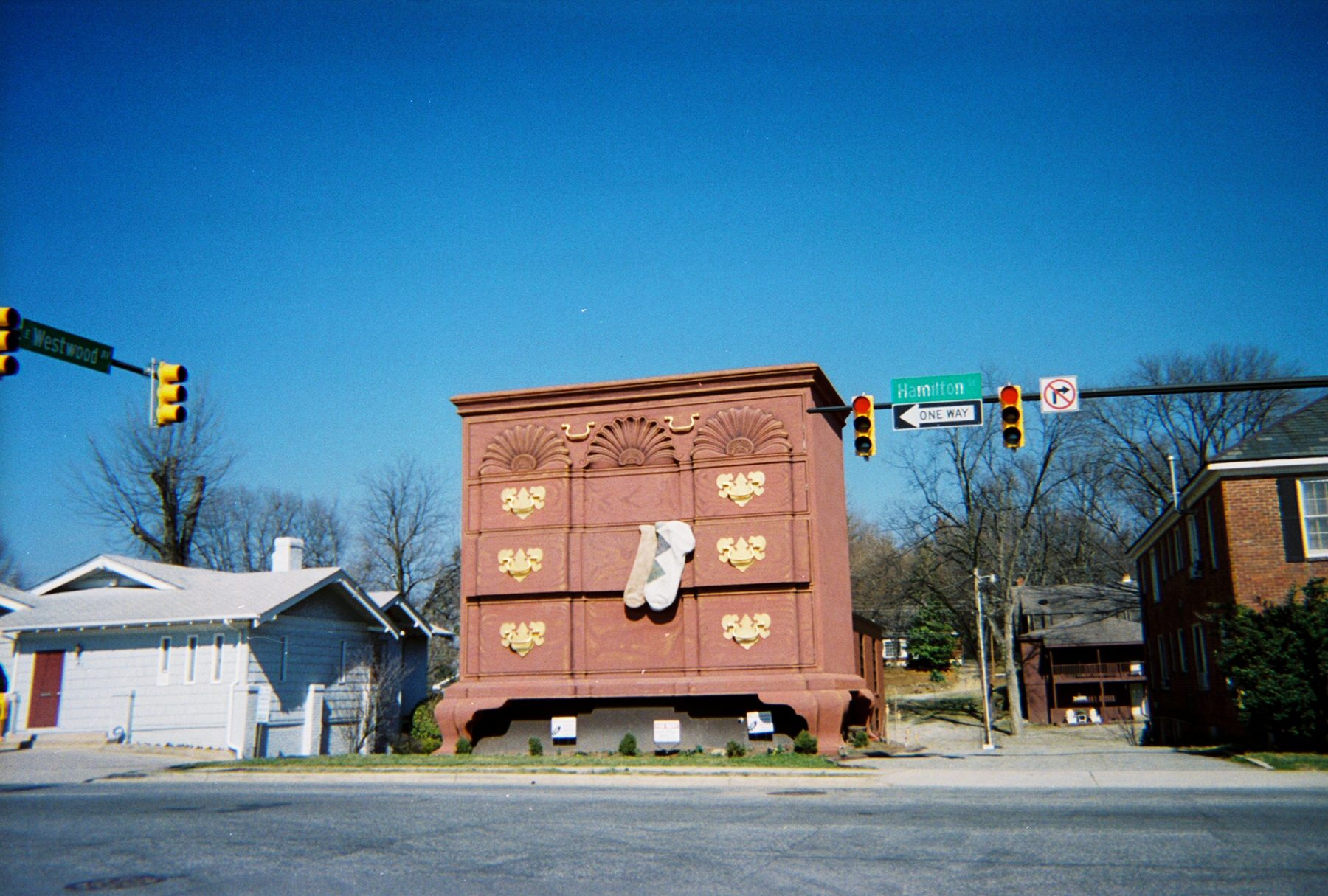
High Point has always understood advertising through scale. In 1926 the city built a giant bureau on North Hamilton Street, first labeled the Bureau of Information, as a roadside welcome center for the furniture trade and a friendly jab at neighboring Thomasville’s Giant Chair. In 1996 Sid Lenger rebuilt it into a proper 38 foot chest of drawers modeled on an eighteenth century Goddard and Townsend block and shell design, with two pairs of oversized socks hung from an open drawer to honor the city’s hosiery mills. The World’s Largest Chest of Drawers is a landmark and a thesis statement at once. It says the furniture is the identity, and the identity is worth stopping the car for.
What the market created, and what it left out
The High Point Market is the largest home furnishings trade show on earth. It runs twice a year, in April and October, across roughly 11 million square feet of exhibition space in about 180 buildings, with something on the order of 2,000 exhibitors. Attendance runs between 70,000 and 80,000 for each show, with recent editions expected to draw more than 75,000 buyers, designers, and press. A 2018 Duke University study put the market’s annual economic impact on the region at about 6.7 billion dollars, and the High Point Market Authority reports that visitor spending alone runs to roughly 506 million dollars a year, including about 130 million on hotels and 96 million on dining.
Those are enormous numbers, and they belong almost entirely to two weeks. This is the central fact of High Point as a place to visit rather than a place to do business. For roughly 48 weeks of the year the town that is built to host 75,000 people is not hosting them. The showrooms that fill the core are closed to the public, and the restaurants and hotels that surge during market settle back into a much smaller everyday demand. High Point is a B2B economy with world class infrastructure and, historically, very little for a B2C visitor to point a weekend at.
The pressure got worse before the town looked for another answer. The making that once anchored the region has thinned badly. After the United States and China reached the bilateral WTO agreement in late 1999, cheaper overseas production pulled the industry apart, and over the following decade North Carolina lost more than half of its furniture manufacturing jobs. The market stayed. The factories largely did not. That left High Point holding the world’s most important furniture gathering and a downtown that, between gatherings, could feel like a set waiting for the show to start.
What is next: building a reason to visit
High Point had already begun answering the between markets problem with concrete and steel before it answered it with art. Starting in 2017, a downtown catalyst effort led by High Point University president Nido Qubein built a ballpark in the heart of the old core. The stadium, now called Truist Point, opened in 2019 as the home of the High Point Rockers of the Atlantic League and won the league’s Ballpark of the Year award that first season. The city put close to 70 million dollars into the surrounding district, and private investors added tens of millions more toward the mixed use development around it. The point was explicit. Give people who are not furniture buyers a reason to come downtown, and give people who live there a downtown worth using.
Little Sally is the next move in that same campaign, and it is a different kind of move. In November 2025 the Danish recycle artist Thomas Dambo installed an eighteen foot troll in a clearing in vine covered woods behind an abandoned sock factory near the corner of West Green Drive and West Grimes Avenue, just west of downtown. Dambo and a team of local volunteers built her over about two weeks out of hundreds of pieces of scrap wood and found wooden objects, and in a detail that is pure High Point, her hair is made of table and chair legs in honor of the city’s furniture trade. She is free to visit, at 726 West Grimes Avenue, and Visit High Point built a small program around her with a troll map and Troll Hunter discounts at more than ten local hotels, restaurants, and bars.
What happened next is the reason this is a case study and not a press release. By late December 2025, roughly eight weeks after the unveiling, Little Sally had drawn more than 31,000 visitors from 41 different states. Melody Burnett, the president of Visit High Point, told WUNC it was premature to put an economic figure on her, which is the honest thing to say, but the multi state pull was already visible in the parking lot. For a town whose visitor economy had been almost entirely a trade audience, tens of thousands of families arriving in the dead of winter for something free is a category change, not a rounding error. Dambo, for his part, framed the appeal in terms that have nothing to do with commerce. His art works, he told WUNC, because it is not trying to sell people something. It is made with people’s hands, it is right there, and it has a pure, good intention behind it.
The honest caveat is that Little Sally is not unique to High Point, and the city should not pretend otherwise. She is one of seven Thomas Dambo trolls installed across North Carolina as the largest Dambo project in the United States: five live in Raleigh’s Dorothea Dix Park, one is Big Pete in Charlotte’s River District, at 65 feet long the largest of the group, and Little Sally is the one in High Point. All seven share a single story, a quest to protect an ancient Grandmother Tree, which is designed to send visitors on a statewide hunt from one troll to the next. That is good for North Carolina and a little complicated for any one town, because the same feature that draws a crowd also spreads it across six other places. A Dambo troll is a strong anchor. It is not an exclusive one, and a fair reading of High Point’s position has to hold both of those facts at once.
Still, the play is the right one, and it echoes a pattern Creative City Developments has documented elsewhere. In Detroit Lakes, Minnesota, a Dambo troll became a measurable boost to local tourism and the local economy, and the mechanics there are the mechanics here. A free, photogenic, family friendly object gives a town a reason to be visited on a normal day, generates the kind of shared photos that no advertising budget can buy, and pulls people past the one landmark and into the restaurants and shops around it. High Point is running that play with an unusually strong base to build on, a globally known name and 11 million square feet of infrastructure, and an unusually specific weakness to fix, a downtown built for a trade that visits twice a year.
Why other towns should watch High Point
The lesson High Point offers is not about trolls. It is about the difference between being important and being visited. For a century the city solved the first problem completely. It made itself indispensable to an entire industry, and it still is. The second problem it barely touched until recently, and the tools it is reaching for now, a ballpark, a public sculpture, a downtown people can walk on a Wednesday, are available to almost any town willing to commit to them. High Point’s Visitor Impact Score of 76, On the Map, reflects exactly this split. The brand and the stay infrastructure are strong. The curb and downtown categories, the parts a casual visitor actually walks through between markets, are where the work remains. Little Sally is eight weeks old and already the most convincing evidence in years that the work is worth doing.