How Gloucester earned the score
Population 29,729 (US Census 2020)
Situation The oldest seaport in America, settled 1623 on Cape Ann, still a working fishing port under long industry decline.
Action Protected a genuinely working waterfront and let artists, writers and filmmakers turn the labor into a national story.
Result A Destination Leader draw: second-ranked Massachusetts fishing port at about $53.2 million in 2018 landings, plus heritage, arts and film fame.

Come into Gloucester Harbor on a working morning and the first thing you notice is that nothing has been arranged for you. Draggers are landing fish at the State Fish Pier. Gulls work the culls. The air smells of diesel, salt and bait. This is the oldest seaport in America, settled in 1623 by men from Dorchester, England, at the spot now called Stage Fort Park, and it is still, four centuries later, a genuinely working fishing port. That single fact is the whole story, and it is why a small city of just under thirty thousand people carries a national reputation far larger than its size.
Gloucester sits on Cape Ann, about thirty miles northeast of Boston, on a granite arm that pushes into the cold, productive water of the Gulf of Maine. Samuel de Champlain mapped the harbor in 1605 and 1606. The English colonists arrived in 1623, incorporated the town in 1642 and named it for Gloucester in England. The land was poor for farming, so the settlement nearly failed. What saved it was the water. By the middle of the eighteenth century, Gloucester schooners were working the offshore banks, and between 1895 and 1925 the port accounted for roughly 29 percent of all United States groundfish landings from the Northwest Atlantic. For a stretch of history, this one harbor fed a large part of the country.
That is worth pausing on, because it explains why Gloucester scores the way it does. Most of the towns in this field study had to reach for an identity. They found a mural, a festival, a fiberglass roadside figure, and built a visitor economy on top of it. Gloucester’s draw is older than the country. It is the reason the town exists at all. When the Visitor Impact Score reads Gloucester’s Unique Hook as a genuinely category-defining multiplier, it is not measuring a slogan. It is measuring the fact that no other place in the United States can claim to be the oldest working seaport, because there is only one, and this is it.
How a fishing town found its thing
Most towns in this series had to invent an identity. Gloucester did not. Its anchor was handed to it by geography and paid for, over and over, in lives. The town has lost an estimated 5,000 or more men to the sea across its history, and that loss is not hidden. It is cast in bronze at the head of the harbor.
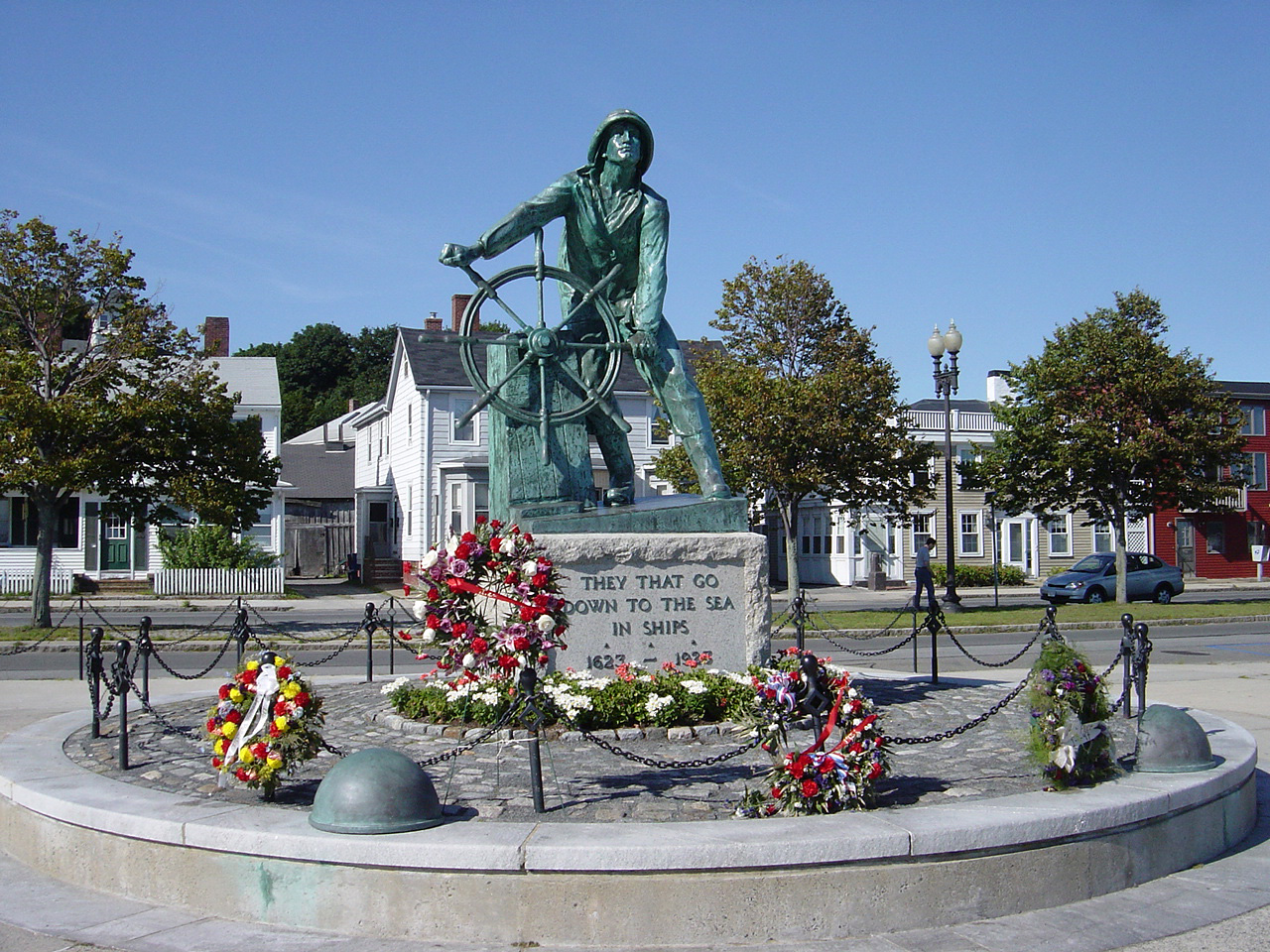
The “Man at the Wheel,” officially the Gloucester Fishermen’s Memorial, is an eight-foot bronze figure leaning into a ship’s wheel, oilskins streaming, eyes fixed on weather you cannot see. Sculptor Leonard Craske modeled it on a local fisherman and it was dedicated in 1925 for the town’s 300th anniversary. The base carries a line from Psalm 107: “They That Go Down To The Sea In Ships, 1623 to 1923.” Nearby, bronze plaques name more than 3,000 lost residents. This is not a mascot. It is a war memorial for a war with the ocean that has never ended.
A visitor feels that difference within minutes. The statue stands on Stacy Boulevard, facing out to the harbor mouth, so the fisherman and the sea he watches are in the same frame. Across a small cove, a companion piece added in 2001, the Gloucester Fishermen’s Wives Memorial, shows a woman and two children scanning the water for a boat that may or may not come home. Together the two monuments do something rare in tourism: they refuse to soften the thing they celebrate. The pull for a visitor is not novelty. It is authenticity, and authenticity is exactly the quality that cannot be manufactured by a marketing committee.
How the town built the story around the work
A working port is the anchor, but Gloucester did something few resource towns manage: it let artists and writers turn the labor into a story that outlived any single season’s catch. Rudyard Kipling set “Captains Courageous” on a Gloucester schooner in 1897. The painter Fitz Henry Lane, born in Gloucester, made the harbor’s light famous a generation earlier. Winslow Homer spent the summers of 1873 and 1880 here, staying on Ten Pound Island in the middle of the busy harbor, and produced more than a hundred watercolors in 1880 alone, the most productive season of his life. The Cape Ann Museum, whose director has called Gloucester Harbor “probably America’s most painted harbor,” holds the deepest collection of that work.
The art was never separate from the fishing. Rocky Neck, a small peninsula inside the working harbor in East Gloucester, is the oldest continuously operating art colony in the United States, with more than twenty galleries and a cultural district that still runs Culture Splash on Thursday nights in July and August. On a bluff over the harbor stands Hammond Castle, a medieval-style stone house built between 1926 and 1929 by the inventor John Hays Hammond Jr., who tested his radio-controlled boats in the harbor below and reportedly spooked fishermen who thought the unmanned craft were ghost ships.

What the story created, in numbers
Then, in October 1991, the story found its widest audience through its oldest subject: loss. The Gloucester swordfishing boat Andrea Gail sailed east and was caught in what became known as “The Perfect Storm,” the unnamed system that merged off the New England coast with winds recorded up to 120 miles per hour. Six men were lost on October 30, 1991: Frank “Billy” Tyne Jr., Michael Moran, Dale Murphy, Alfred Pierre, Robert Shatford and David Sullivan. Sebastian Junger’s 1997 bestseller “The Perfect Storm” and the 2000 film that followed put those names, and Gloucester, in front of tens of millions of people. Their names are engraved at the base of the same memorial that has counted the town’s dead since 1925.
The heritage the town leaned on is real, and so is the industry decline it is leaning against. Groundfish revenue for Gloucester and North Shore vessels fell an estimated 67 percent over the 2010 to 2014 period. And yet the port did not die. Gloucester still ranked second among Massachusetts commercial ports, with about $53.2 million, or 8.2 percent, of the state’s roughly $647 million in seafood landings in 2018. In 2016 the value of its landings rose 18 percent to about $52 million from $44 million the year before. National Geographic’s “Wickid Tuna,” filmed on the Gloucester waterfront since 2012, turned the daily reality of the port into a national television draw and, for the captains involved, a second income stream.
The visitor economy grew in the same water. Whale watching runs twelve miles offshore to Stellwagen Bank National Marine Sanctuary, one of the most reliable whale grounds on the East Coast, served by a fleet of Gloucester operators. Good Harbor Beach draws summer crowds to its long curve of white sand. The Gloucester Schooner Festival fills the harbor over Labor Day weekend with the Parade of Sail, the Mayor’s Cup races and a Boat Parade of Lights, while St. Peter’s Fiesta each June carries the Italian-American fishing community’s patron saint through the streets. None of it is staged for tourists first. It is the town’s own life, opened to visitors.
Look at how the score distributes and you can read the town’s real position. Anchor Activity lands at 93, an A, because the things a visitor actually does here, going out to Stellwagen, sailing on a schooner, standing at the memorial, walking Rocky Neck, are unusually deep and genuinely bookable. The Unique Hook multiplier is the highest band the framework awards. Where Gloucester sits lower is on the categories that reward a polished, single-owner destination brand: Web, Stay and Return all fall in the C-plus range, and Curb Appeal remains provisional until a field visit. That is the honest shape of a real working city rather than a curated resort. Gloucester is not trying to be seamless. Its edges are the point.
What is next for Gloucester
The tension is honest and worth naming. A town whose anchor is a shrinking industry cannot simply wait for the fish to return. Gloucester’s own Harbor Plan Committee has recognized the need to diversify the maritime economy, protecting the working waterfront while making room for research, marine trades, tourism and the arts. The risk in any heritage town is that the work becomes a costume, that the last real dragger is replaced by a photograph of one. Gloucester has not crossed that line. The fish pier still lands fish. The memorial still adds names.
The diversification is already visible if you know where to look. The Gloucester Marine Genomics Institute and a growing cluster of marine science and biotech tenants have moved onto the waterfront, keeping the harbor economically alive without evicting the fleet. The Beauport Hotel and a set of waterfront inns give visitors a reason to stay overnight rather than pass through on a day trip from Boston. Cruise ships and the whale watch fleet share the same channel the draggers use. The city’s task, and it is a genuinely hard one, is to grow those newer uses without letting real estate pressure quietly push out the low-margin fishing infrastructure that gives the whole place its meaning. Protect the fish pier and you protect the story. Lose it and Gloucester becomes a very pretty town that used to fish.
That is the lesson other towns can take, and it is the opposite of the usual advice. Gloucester did not manufacture a hook. It protected one it already had, and it let its writers, painters and filmmakers tell the truth about it, including the hard parts. For a small town looking to build a durable draw, the Gloucester play is patient and unglamorous: keep the real industry alive as long as you possibly can, treat your losses as heritage rather than hiding them, and let the culture grow from the work instead of replacing it. A place that leads with a manufactured attraction, the way Detroit Lakes did with Thomas Dambo’s trolls, can win visitors fast. A place like Gloucester, that leads with four centuries of genuine work, wins something harder to copy: belief.