How Chincoteague earned the score
Population 3,344 (US Census 2020), a barrier island in Accomack County off Virginia’s Eastern Shore.
Situation The only resort island in Virginia and the gateway to Assateague’s wild ponies, already known for its salt oysters.
Action Turned a 1925 firehouse fundraiser, the Pony Swim, into a protected century-old tradition, let a 1947 novel amplify it nationally, and tied it to conservation.
Result More than 1.3 million visitors in 2024 and 192 million dollars in Accomack County tourism spending; the 2025 centennial auction crossed 1 million dollars for the first time.

There is a moment on the last Wednesday of July when a channel of salt water goes quiet. The boats cut their engines. A few thousand people stand on the marsh edge of Chincoteague Island with their feet in the mud, and for a long minute the only sound is the wind and the horses. Then the herd steps off the far bank of Assateague, finds the current, and swims. It takes about five minutes. Nobody who has seen it forgets it, and a surprising number of the people watching first learned this scene existed from a library book they read when they were nine.
Chincoteague, Virginia, is a barrier island town of 3,344 people, according to the 2020 US Census, sitting off the Eastern Shore in Accomack County. It is the only resort island in Virginia, and it is the front door to Assateague Island National Seashore and the wild ponies that live there. On a map it is a small hook of land reached by one causeway. In the American imagination it is something much larger, because in 1947 a children’s author named Marguerite Henry turned a local firehouse fundraiser into a legend, and the town has been living inside that story, and improving on it, ever since.
Let’s meet Chincoteague, Virginia
The island earns its living the way it always has, off the water and off the people the water draws. Before the ponies were famous, Chincoteague was an oyster town. The waters of Chincoteague Bay run unusually salty, between roughly 28 and 35 parts per thousand, because no major freshwater river empties into them. That salinity gives the local oyster its firm meat and its sharp, briny finish, the flavor that earned the “Chincoteague Salt” its name. When the railroad reached the mainland in 1876, watermen could ship fresh harvests overnight to high-end restaurants in Manhattan, and the island’s name became a luxury seafood brand decades before it became a pony brand. That trade never fully left. Cherrystone Aqua-Farms, founded on the Eastern Shore in 1895, still farms these waters, and Virginia growers now produce most of the state’s oysters through aquaculture, a technique local families helped pioneer by moving milder seed oysters into the briny bay to take on the signature taste.
So the town was already a place that knew how to sell what only it had. The ponies gave it something that could not be shipped anywhere at all. You had to come to the island to see them, and once a year you had to come at a very specific time.
The fire, the firemen, and the first swim
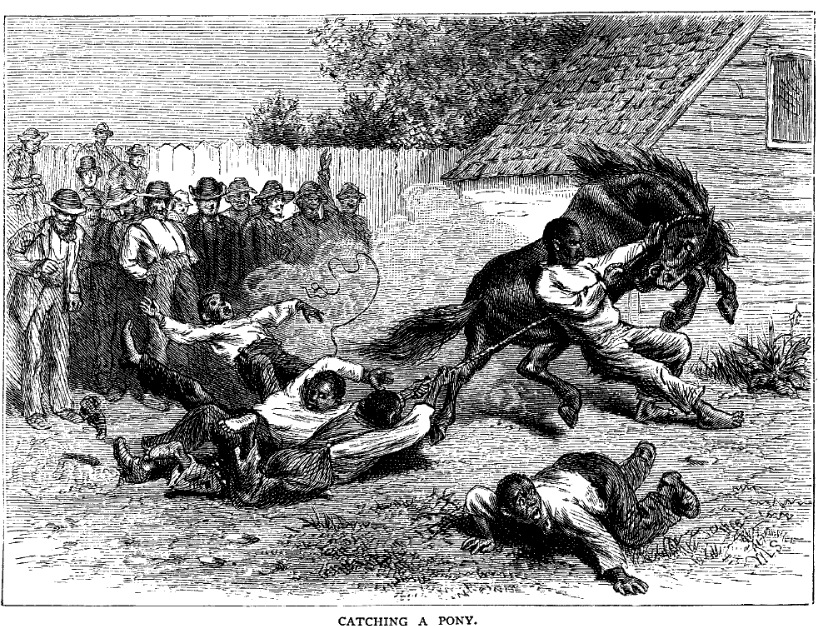
The Pony Swim did not begin as a spectacle. It began as a bill that needed paying. Two fires, in 1920 and again in 1924, tore through Chincoteague’s growing downtown, and in response twenty-five men organized the Chincoteague Volunteer Fire Company. They needed a fire truck, a 750-gallon pumper, and enough hose to protect a town built largely of wood on a narrow island. To raise the money they held a carnival, and the centerpiece of that carnival was Pony Penning Day. The firemen rounded up the wild ponies grazing on Assateague, swam them across the Assateague Channel to Chincoteague, and auctioned the foals. The proceeds went toward the equipment.
The first official swim in 1925 is said to have drawn 15,000 spectators to an island of a few thousand residents. By 1937 the crowd was estimated at 25,000. What started as a way to buy a hose reel had become the reason the wider world knew the island existed. And the arrangement had a quiet genius to it that still holds a century later. The fire company owns the Virginia herd. Every spring the mares foal, every July the foals are auctioned, and the sale controls the herd size so the fragile refuge is not overgrazed. The event pays for the fire department, funds the ponies’ veterinary care, and keeps the herd healthy, all at once. The tradition still runs on the last Wednesday and Thursday of July, exactly as it did in 1925. In 2023 the Commonwealth of Virginia named the Chincoteague pony the official pony of the state.
The book that made a brand
In 1946 a filly was born on Chincoteague at the Beebe Ranch, home to Clarence and Ida Beebe and their grandchildren, Paul and Maureen. Marguerite Henry, an author working with the illustrator Wesley Dennis, came to the island for Pony Penning and fell for the foal. She bought the pony for 150 dollars, on the condition, which Clarence Beebe had insisted upon, that his grandchildren Paul and Maureen appear in the book. The pony was named Misty. The book, “Misty of Chincoteague,” was published by Rand McNally in 1947 and named a Newbery Honor Book, the runner-up to the year’s top prize in American children’s literature.
It is hard to overstate what that single book did. Henry took a firehouse fundraiser on an island most Americans could not find on a map and told it as a story about two children, a wild mare, and a foal they raise and love. Generations of readers, especially young readers who loved horses, absorbed Chincoteague as a real place they could actually go. Misty herself became a local celebrity, toured for the 1961 film adaptation, and is now preserved and on display, along with her foal Stormy, at the Museum of Chincoteague Island. Maureen Beebe lived on the island as a familiar presence until her death in 2019 at 81. In June 2023 the museum purchased the Beebe Ranch itself to preserve it, so the actual barn where the real Misty was foaled is now a place visitors can stand.
This is the rare case of a town’s identity being handed to it by an outsider, in print, and the town choosing to honor the gift rather than exploit it. The story is real. The firemen are real. The ranch is real. The island did not manufacture a legend. A beloved book noticed a true thing the island was already doing, and the island kept doing it.
What the island built

Turn the page to today and the numbers are substantial for a town this size. Chincoteague drew more than 1.3 million visitors in 2024, according to the Chincoteague Chamber of Commerce, with the Pony Swim, the Oyster Festival, and the wildlife refuge cited as the biggest draws. The refuge alone, the Chincoteague National Wildlife Refuge on the Virginia end of Assateague, records roughly 1.4 million visits a year, which ranks it among the most visited national wildlife refuges in the country.
Those visitors move real money on the Eastern Shore. Tourism spending in Accomack County, anchored by Chincoteague, reached 192 million dollars, according to reporting on the Virginia Tourism Corporation figures. Lodging led at 72.4 million dollars, food and beverage followed at 55 million, transportation added 27.6 million, and recreation and retail contributed 19.9 million and 17.3 million respectively. For comparison, county tourism spending was 168.5 million dollars in 2021, so the trend has run firmly upward.
The 2025 season, the 100th, showed how much the event has grown as a draw. The centennial auction crossed a mark no Chincoteague sale had ever reached, raising a record 1,008,100 dollars from 94 ponies. The average price was 10,724 dollars. Virginia First Lady Suzanne Youngkin bought a take-home pony for a record 50,000 dollars. A buyback foal, one auctioned for the honor of naming it before it returns to the herd, drew 100,000 dollars from a group of more than 550 people who named her Marnie, after the crew of the Marine Electric, a ship that sank off Assateague in 1983. The buyback money stays with the herd, the take-home money funds the fire company, and the ponies that are sold keep the refuge from being overgrazed. A hundred years on, the machine the twenty-five firemen built still works exactly as designed.
More than a one-day town
The risk of any single-event town is that it becomes a one-day town, mobbed for a week in July and empty the rest of the year. Chincoteague has spent decades building reasons to come on the other 358 days, and the geography did much of the work for it.
The Chincoteague National Wildlife Refuge is one of the premier birding sites on the Atlantic Flyway. More than 320 species use the refuge during migration, and in fall and winter the impoundments fill with thousands of snow geese, ducks, and swans. Inside the refuge stands the Assateague Lighthouse, a 142-foot brick tower banded in red and white, completed in 1867 and still an active navigational beacon, open for climbing on public tour days. Beyond it lie miles of undeveloped Atlantic beach, most of it protected from development since Assateague Island National Seashore was established in 1965.
Then there is the surprise on the northern horizon. NASA’s Wallops Flight Facility sits on Wallops Island just across the water, and Chincoteague and Assateague are among the best public spots on the East Coast to watch a rocket launch. The Wallops Visitor Center sits about four miles from the pads, and the Chamber of Commerce keeps a running guide to viewing sites on both islands. It is a genuinely strange and wonderful combination: wild horses grazing a salt marsh under a sky that occasionally lights up with a rocket bound for the International Space Station.
Add the oyster heritage back in, the Chincoteague Oyster Festival every October, the working seafood culture you can still taste at the dock, and the Museum of Chincoteague Island with the real Misty inside, and the island reads less like a theme park and more like a place with several honest reasons to exist. A visitor today can climb a lighthouse in the morning, watch a hundred bird species from a wildlife loop at midday, eat an oyster pulled from water you can see, and stand where a children’s book was born, all within a few miles.
Why other towns should follow Chincoteague’s lead
Chincoteague ran a play most towns can run, if they are patient and honest about it. It found one true, un-fakeable thing, the wild ponies and the swim, and it protected that thing for a hundred years instead of cashing it out. It let an outside storyteller, Marguerite Henry, amplify the tradition into a national brand, and then it kept the tradition real enough to deserve the attention. It tied the whole enterprise to conservation, so the event that draws the crowds is the same event that keeps the herd and the refuge healthy. And it built a wider itinerary, birding, beach, lighthouse, oysters, rockets, so the season did not collapse into a single week.
The lesson is not that every town has wild ponies. It is that most towns have some true thing, an industry, a landscape, a tradition, a story someone once told about them, that is theirs and no one else’s. Chincoteague’s genius was recognizing which of its true things could not be shipped to Manhattan in a railcar, and then swimming it across a channel every July for a hundred years. A folk tradition became a fire budget, became a book, became a brand, became a 192-million-dollar regional economy, and none of it required inventing anything. It only required the island to keep being, deliberately and proudly, the one place this happens.