How Leavenworth earned the score
Population 2,263 (US Census 2020), up from about 1,300 in the early 1980s.
Situation A failed logging town after the Great Northern Railway moved its regional operations to Wenatchee in 1925 and the mills closed through the Depression.
Action Committed to a Bavarian-Swiss alpine theme starting in 1965, enforced through a design review board that governs every commercial building.
Result Roughly 2 million visitors a year, a 100.0 capped Downtown score, and a resident population up about fifty percent since the rebuild.
Let’s Meet Leavenworth, Washington
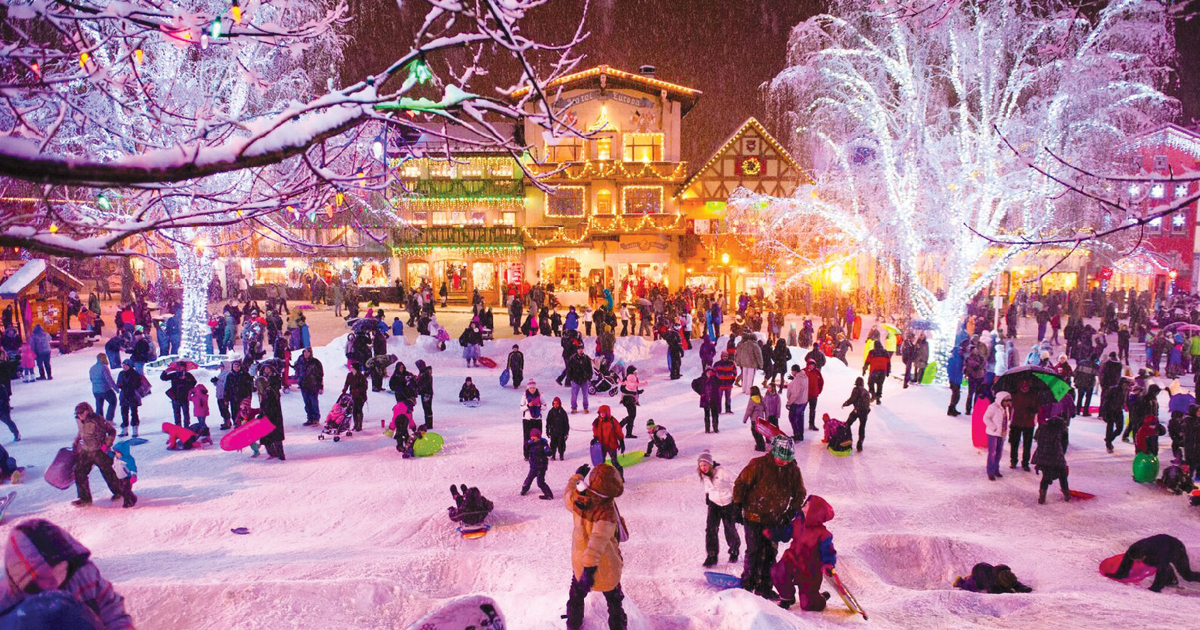
Leavenworth is the textbook citation in destination-development circles. The town sits on US-2 in the eastern foothills of the Washington Cascades, two and a half hours from Seattle and roughly thirty minutes north of Wenatchee. The resident population is about 2,000, up from around 1,300 in the early 1980s. The annual visitor count is around 2 million. That ratio, a thousand visitors per resident, is the highest among CCD case studies and the cleanest example anywhere of a complete theme-town transformation working at scale. The town does this on the back of a single design decision: every commercial building must be Bavarian. Including the McDonald’s. Including the Safeway. Including the gas stations.
The original CCD case study leads with the founding story (failed logging town, 1962 Project LIFE committee, Ted Price and Bob Rodgers, the Solvang trip) and the takeaway about pulling traffic off a nearby highway. The deeper story is that the theme is not a costume. It is enforced architecture, an active design review board, a sixty-year ordinance discipline, and a programming calendar designed around being unmistakably the Bavarian village in the Pacific Northwest. Roger Brooks treats Leavenworth as the case study that proves towns can manufacture a destination identity from scratch if they commit to the design.
History
The valley at the confluence of Icicle Creek and the Wenatchee River was Wenatchi and Yakama territory before settlement. The villages near modern-day Leavenworth were a camas and root-gathering area. Both nations were signatories to the 1855 Treaty of Walla Walla. The promised Wenatchi reservation, 36 square miles at the confluence, was never surveyed. Most Wenatchi members relocated to the Colville and Yakama reservations in the early twentieth century.
The first non-native settlers, John Emig and Nicholas Kinscherf, filed homestead claims near Icicle Creek in 1885. A small community called Icicle Flats took shape on the south side of the Wenatchee River in 1891. The town’s modern footprint was set in October 1892, when the Great Northern Railway purchased land on the north side of the river for a division point and railyard on its Stevens Pass route, completed January 1893. The settlement moved across the river and was platted on the new site, taking the name Leavenworth after Charles Leavenworth, a Portland-based land investor with the Okanogan Investment Company who surveyed the streets. Within a few months the town had grown to about 700 people and over 40 businesses. Lafayette Lamb arrived from Clinton, Iowa, in 1903 and built what was then the second-largest sawmill in Washington. Three major fires at the turn of the twentieth century burned through significant portions of the early commercial core. Leavenworth was incorporated as a city on September 5, 1906.
Then the rug came out. The Great Northern Railway moved its regional operations to Wenatchee in 1925, which gutted the wage base. The lumber mills closed through the late 1920s and into the Depression. By the 1950s the population was in decline, storefronts were closing, and Leavenworth was on the same path as a long list of failed inland-Northwest mill towns. The town tried a small tourism strategy as early as 1929, opening a ski jump. It was not enough.

Leavenworth’s Creative City Development
In 1962, the Project LIFE (Leavenworth Improvement For Everyone) Committee was formed in partnership with the University of Washington to investigate revitalization strategies. The Bavarian-Swiss alpine theme came from two Seattle businessmen, Ted Price and Bob Rodgers, who had purchased a failing cafe at Coles Corner in 1960 and renamed it The Squirrel Tree. Rodgers had been deployed to Bavaria during World War II with the U.S. Army and remembered the architecture. Price chaired the Project LIFE tourism subcommittee. In 1965 the pair led a delegation to Solvang, California, the Danish-themed town outside Santa Barbara, to build support for the idea on the ground.
The Project LIFE members began acquiring properties and were joined by architects Earl Petersen, who had designed Solvang’s Danish buildings, and the Germany-born designer Heinz Ulbricht. The first building rebuilt in the Bavarian style was the Chikamin Hotel, damaged in a fire, which reopened as the Edelweiss Hotel on July 1, 1965, named for the state flower of Bavaria. Several more buildings were renovated later that year, with the explicit goal of having the town ready for the 1966 Washington State Autumn Leaf Festival. By 1970 Leavenworth was hosting multiple annual festivals and had formed a design review board to enforce the standards Project LIFE had set.
The Bavarian design ordinance
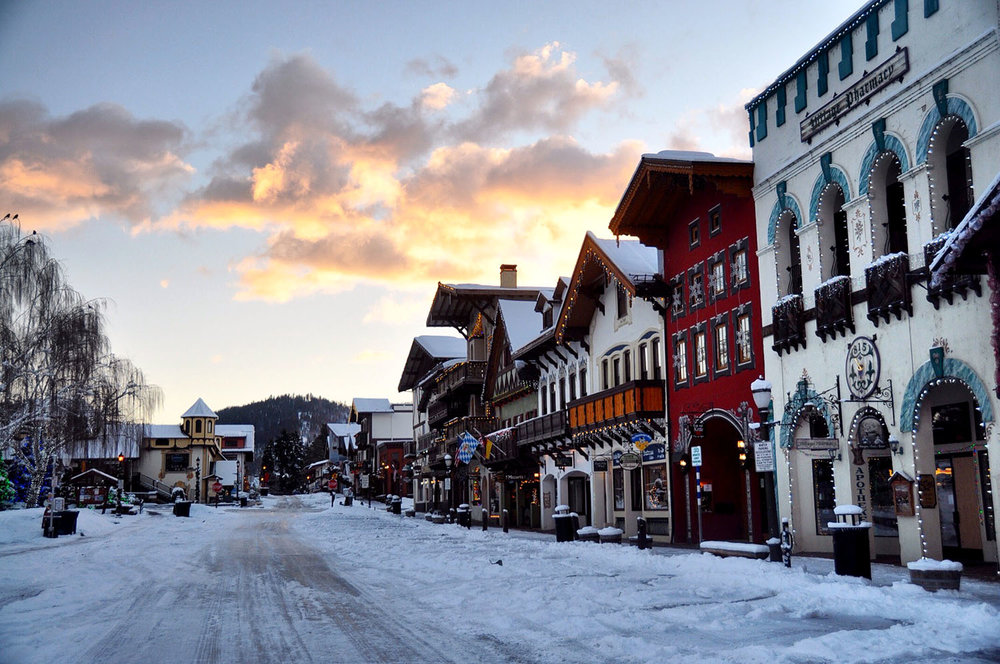
The piece of the Leavenworth story that other towns most often miss is the design ordinance. Every commercial building must conform to the Bavarian aesthetic, with consistent rooflines, half-timbered facade treatments, painted trim, and signage typefaces. The design review board has authority to deny permits that do not comply. The McDonald’s franchise complies. The Safeway complies. The fuel stations comply. The result, sixty years later, is that the town does not read as a single theme block surrounded by ordinary commercial sprawl; it reads as one of the more consistent built environments anywhere in the American West. The discipline is the moat. Other towns can theme a Main Street; very few can theme everything.
The festival calendar
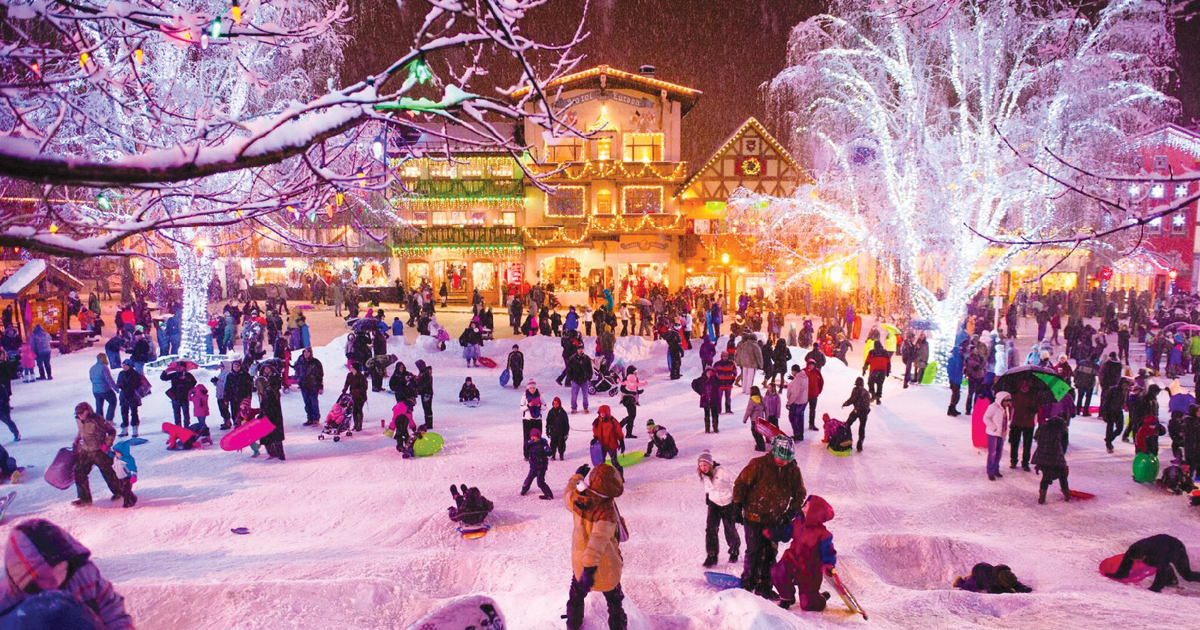
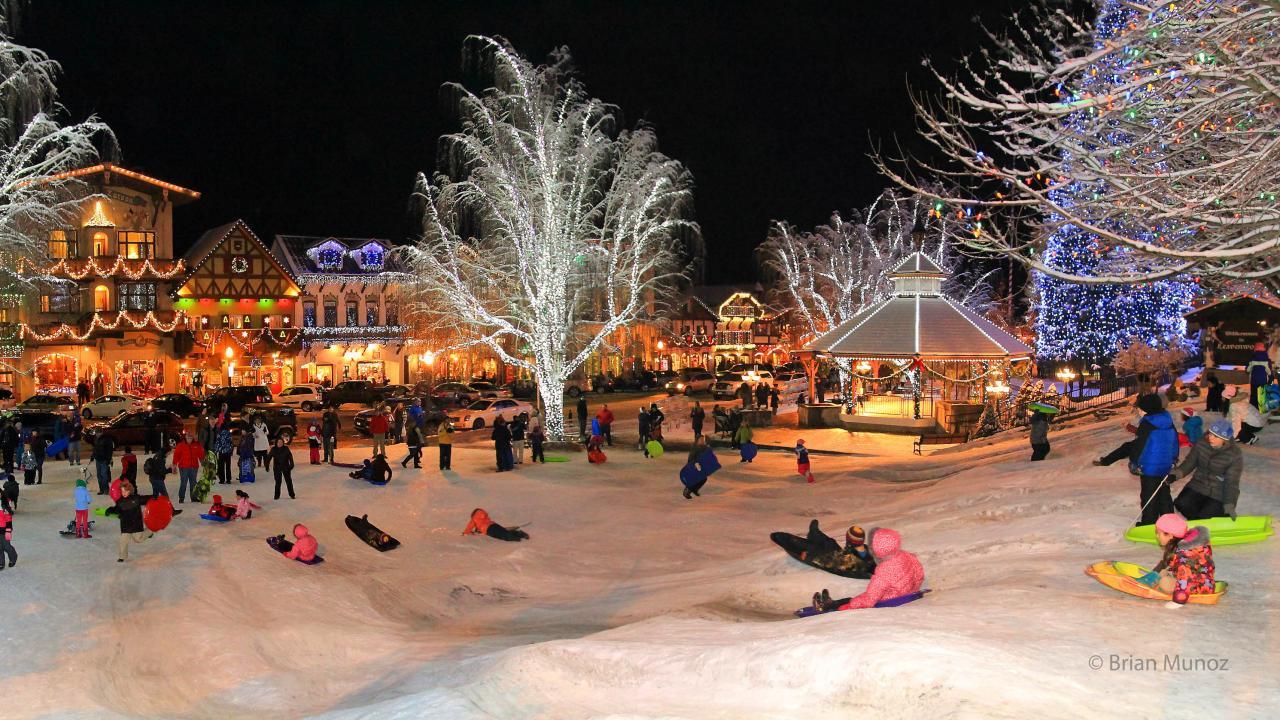
Leavenworth runs seven or more major recurring annual events. Maifest, in May, opens the season. The Accordion Festival, in June, is a four-day event that draws international participation. Leavenworth Summer Theater runs July and August. The Autumn Leaf Festival, in September, has run since 1964 and is the festival around which the Bavarian rebuild was originally timed. Oktoberfest, across three weekends in October, is the largest single event of the year. Christmas Lighting and Christmastown, from Thanksgiving through February, is the multi-week winter centerpiece. The Winter Karneval has been named one of the top three winter carnivals in the United States by TimeOut. The town runs Bavarian-themed sleigh and carriage rides through the snow season.
The Nutcracker Museum and the cultural depth
One of the unexpected anchors in Leavenworth is the Nutcracker Museum, a privately operated institution with more than 9,000 nutcrackers on display, including pieces dating to the twelfth century. The collection is unusual on a global scale, not just a regional one. Combined with Icicle Brewing, the Munchen Haus beer hall, the Reindeer Farm, and the Alpine Coaster, the cultural and food layer goes deeper than the surface architecture would suggest. The town is not just dressed up; the food, the merchandise, the festival programming, and the off-the-shelf cultural infrastructure all reinforce the Bavarian identity.

By the Numbers
The 2026 Visitor Information Score for Leavenworth came out at 100.0 of 100, capped, A-plus grade, with a 1.14 uniqueness multiplier. The category leader was Downtown at 100.0 (the seven-plus annual recurring events fill the rubric); the laggard was Stay at 82.4, mostly because the town markets lodging as a category directory rather than a packages-and-promotions front door. Visit Leavenworth WA Facebook carries about 191,000 followers. Instagram @visitleavenworthwa is at about 67,000 followers and 2,583 posts. The Instagram location page for Leavenworth WA has over 591,000 tagged posts. The Bavarian Lodge, the Post Hotel Leavenworth, Icicle Village Resort, and the Enzian Inn anchor the 4-star tier. CrimeGrade gives the town a low overall safety grade, which is largely a property crime artifact of a heavy retail-tourism environment in a small resident population, not a reflection of risk to residents.
Community Benefits
The resident population has grown roughly fifty percent since the rebuild started, from about 1,300 to about 2,000. Several generations of residents have grown up working in the visitor economy. The valley still suffers from wildfire risk: the 1994 Rat Creek Fire grew to over 24,000 acres in three weeks; the December 2025 Wenatchee River flood crested at 17 feet and forced the temporary postponement of the Christmastown festival before power was restored and the lights came back on. The festival calendar, the design discipline, and the embedded tourism economy gave the town the financial cushion to absorb those events. Most former logging towns of comparable size in the Cascades did not get that cushion.
Why Other Towns Should Follow Leavenworth’s Lead
The lesson from Leavenworth is the one most towns find hardest to act on: pick one identity, commit to it across every building permit, and hold the line for sixty years. The reason Leavenworth works and most theme-town imitators do not is that the Bavarian identity is enforced everywhere, not just on a feature block. The design review board is the unglamorous backbone of the model. The lesson scales down: if your town has a real identity (a German heritage, a mining history, a maritime past, a literary anchor), the question is not whether to lean into it, the question is whether you can enforce it through the next forty years of zoning decisions. Most towns lose the discipline somewhere along the way. Leavenworth did not, and that is the entire story.