How Gallup earned the score
Population 21,899 (2020 census); more than half (51.2%) of residents are Native American, at 6,647 feet in McKinley County, western New Mexico.
Situation A town the railroad built in 1881 to be passed through, a paymaster’s railhead most travelers were meant to roll straight past on the way to somewhere greener.
Action Gallup stacked three identities that reinforced each other: the Inter-Tribal Indian Ceremonial (1922), the wholesale Native arts trade, and one of the best-preserved stretches of Route 66 in America.
Result The “Indian Capital of the World,” responsible for more than 70% of US Native jewelry, with tourism touching roughly 23% of county employment. Its Visitor Impact Score is 72, the On the Map band.
A town the railroad built to be passed through
In 1881 the Atlantic and Pacific Railroad pushed its line across the high country of western New Mexico and needed somewhere to base its paymaster. That man was David L. Gallup, and the camp that grew around his office took his name. (Wikipedia) The town sat at 6,647 feet, ringed by red sandstone and sage, the kind of place the timetable was designed to roll through on the way to somewhere greener. (Wikipedia)
What the railroad surveyors could not see on their maps was that they had laid track straight through the middle of something far older than any timetable. Long before there was a Gallup, the Diné (Navajo) knew this crossroads as Na’Nizhoozhi, “the bridge,” a meeting place where Hopi, Zuni, Laguna, Acoma, and Apache people had traded for generations. (Visit Gallup) The railhead had been dropped on top of a marketplace that predated it by centuries.

For its first decades Gallup did what railroad and coal towns do. It dug coal, it served the line, and a substantial Native and immigrant workforce kept the trains and the mines running. It was useful. It was not, by any tourist’s definition, a place you went. The question that would define the next hundred years was whether a town could turn a location everyone drove through into a reason to stop.
Turn a fuel stop into a destination
By the early 1920s a handful of Gallup traders, the people who ran the posts swapping goods for Navajo and Zuni silver, weaving, and pottery, understood a hard truth about their town. The trade was real, the artistry was world class, but the visitors who could buy it were rolling past on the rails. The challenge was not to invent an attraction. It was to give people a reason to climb down off the train and stay a night.
That problem sharpened when Route 66 arrived. By 1926 the Mother Road ran straight down the main street, and Gallup became the largest town on the long, lonely stretch between Albuquerque and Flagstaff. (Wikipedia) Now there were two rivers of travelers, the rail line and the highway, and both were still designed to flow through. The town’s task was to dam them, even briefly, and turn passing traffic into trade.
A trade, a Ceremonial, and the Mother Road
One: the Inter-Tribal Indian Ceremonial
On September 28, 1922, those Gallup traders launched the Inter-Tribal Indian Ceremonial, a deliberate effort to draw visitors by showcasing the Native art, dance, and culture already at the town’s doorstep. (NewMexico.org) The first year was a humble affair: travelers pulled into Lyons Memorial Park north of the railway, circled their cars around bonfires, and lit the dancers with their headlights. (NewMexico.org) It grew every year after that, and today it is one of New Mexico’s oldest events, drawing tribes from Oklahoma, Nebraska, Washington, Mexico, and beyond. (NewMexico.org)
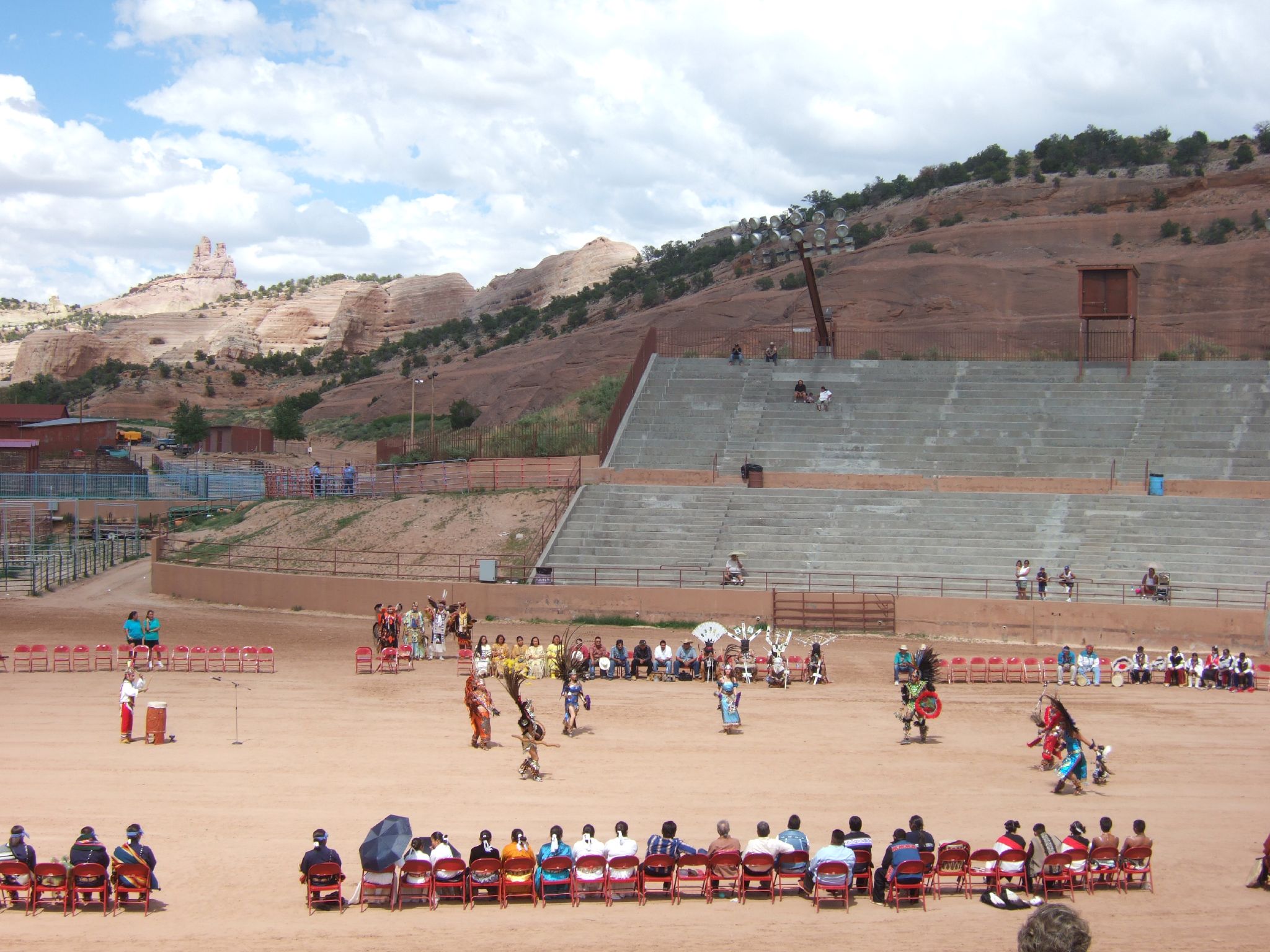
In 1977 the Ceremonial moved to its natural home just outside town, the red sandstone amphitheater of Red Rock Park. (NewMexico.org) The park’s 640 acres of Jurassic Entrada cliffs, the same orange sandstone laid down as ancient dunes, give the dances a backdrop no convention center could buy. (Visit Gallup)
Why a small coal town bet on a cultural festival in 1922
The Ceremonial was, in its plainest reading, a marketing campaign a century ahead of its time. Gallup was a remote coal town on the Santa Fe line with no obvious draw, and the traders backing the event, with help from the Santa Fe Railroad itself, understood that the region’s living Native cultures were an attraction nowhere else could replicate. They were right. Rather than imitate a resort town, Gallup leaned all the way into the one thing that was authentically, unrepeatably its own. That instinct, build on what only you have, is the through line of every chapter of this town’s story.
Two: the trade itself
While the Ceremonial brought people in once a year, the trading posts gave them a reason to come back. Gallup quietly became the wholesale heart of the entire Native arts economy. Today the area is responsible for more than 70% of the nation’s Native American jewelry manufacturing and is home to the largest wholesale Native American art business sector in the United States. (Visit Gallup) Posts like Richardson’s, established in 1913, have kept that trade alive on the same blocks for more than a century. (Richardson Trading)
This is the part visitors underestimate. The silver and turquoise in a Santa Fe gallery or a Scottsdale boutique very often began here, bought and sold across a worn counter in Gallup. The town did not just host the art. It became the place the art flowed through, which is a far more durable kind of importance.
Three: the Mother Road
Then there is Route 66, and Gallup wears it better than almost any town left on the map. The highway threads roughly 13.5 continuous miles through the city, longer than in most Route 66 towns, lined with the neon and motor courts of the road’s golden age. (Visit Gallup) The town is even name-checked in the lyrics of Bobby Troup’s “(Get Your Kicks on) Route 66,” forever filed between Flagstaff and Winona. (Wikipedia)

The El Rancho and the Hollywood years
In 1936, R.E. “Griff” Griffith, brother of the pioneering film director D.W. Griffith, built the El Rancho Hotel on Route 66. (Wikipedia) The rugged mesas and ridgelines around town were exactly the landscape Hollywood needed, and the El Rancho became the production base for it. Through the 1930s and 1940s, more than 100 Westerns were filmed around Gallup. (New Mexico Magazine)
The guest book reads like a studio roster: John Wayne, Ronald Reagan, Katharine Hepburn, Humphrey Bogart, Kirk Douglas, Gregory Peck, and more all slept under its “Charm of Yesterday, Convenience of Tomorrow” neon. (New Mexico Magazine) The hotel was added to the National Register of Historic Places on January 14, 1988, and still takes guests today. (Wikipedia)
The hotel that nearly didn’t make it back
The El Rancho’s two-story log-and-stone lobby, with its sweeping double staircase, was built to look like a film set and largely still does. But the building outlived the era that made it. As Route 66 was bypassed and the studios moved on, the hotel slid into disrepair and closed. It might have become another roadside ghost. Instead it was restored and reopened in 1988, the same year it earned its place on the National Register, and the neon went back on. It is one of the clearest pieces of evidence that Gallup’s identity was worth preserving, not paving over.
The Indian Capital of the World
The stacking worked. Gallup today is widely billed as the “Indian Capital of the World,” a claim earned by that 70-percent share of the country’s Native jewelry making and the densest concentration of authentic trading posts left in the Southwest. (Visit Gallup) More than half its residents, 51.2% as of the 2020 census, are Native American, making the culture on display not a performance for tourists but the genuine fabric of the place. (Wikipedia)
That identity now carries real economic weight for a town its size. Tourism touches roughly 23% of all employment in McKinley County, with more than 2,000 people working in the Gallup area’s leisure and hospitality sector. (Gallup Sun) The town supports roughly 2,395 hotel rooms, a remarkable count for a city of about 22,000, evidence of just how many people it is built to host. (Gallup Sun)
None of it came from a natural windfall. There is no coastline, no ski resort, no headline national park inside the city limits. Every visitor draw in Gallup, the Ceremonial, the trade, the preserved Route 66 corridor, the film history, is something the town chose to build, protect, or lean into on purpose. That is exactly the profile that scores well on the things the Visitor Impact Score is built to reward: a clear, ownable, hard-to-copy identity.
The lesson Gallup holds for other towns
Gallup’s Visitor Impact Score of 72, in the On the Map band, reflects a town that punches well above its raw geography. It scores on uniqueness, on a deep cultural anchor, on a genuinely walkable historic downtown, and on a reputation that reaches far past its population. The lesson is not “be Gallup.” It is that a destination is something a community can decide to become.
The biggest opportunity, framed from the public picture, is conversion and storytelling. Gallup has the rooms, the trade, and a 100-year-old marquee event, yet a lot of its traffic is still exactly what it always was: people on their way to somewhere else, the Grand Canyon, Albuquerque, Santa Fe. The upside is turning more of that pass-through volume into overnight stays and repeat visits by telling the Gallup story as loudly off the highway, online and in search, as the El Rancho’s neon tells it on the road. The identity is already world class. The job now is making sure the people driving past, and the people searching online before they ever leave home, actually know it.